The final newsletter of the Horizon Europe project drOp is now available, bringing together three years of work on digitally enabled, community-driven neighbourhood renovation. This edition presents the project’s key insights, methodologies and outcomes from the Santa Ana pilot in Ermua (Spain) and its replication in Elva (Estonia) and Matera (Italy).
At the heart of drOp lies the Integrated Renovation Methodology (IRM) — a structured yet flexible framework for neighbourhood-scale renovation, combining participatory co-governance, social innovation, digital tools, and local economic development. Through a human-centred approach, drOp demonstrates how municipalities can transform ageing social housing districts into inclusive smart neighbourhoods, even without major renovation budgets.
The newsletter highlights:
Final project results, including the IRM, co-governance strategy, LED framework, and the monitoring & evaluation model.
The implementation journey in Santa Ana, where residents co-created a neighbourhood vision, prioritised actions, and helped shape interventions such as the Energy Community, the Neighbourhood Office, the Mapathon, tactical urbanism pilots, and cultural and digital initiatives.
Peer-learning outcomes from Elva and Matera, who adapted and applied drOp tools to build their own strategic and action plans.
The publication of major deliverables:
Evaluation of the IRM performance
Co-governance model implementation
Local Economic Development recommendations
Replication Roadmap
Peer Cities Plans
Through these resources, drOp provides a comprehensive, replicable roadmap for European cities seeking to strengthen participatory renovation, energy transition, urban regeneration, and community resilience at district level.
👉 Download the final drOp Newsletter and explore all knowledge outputs to support your city’s neighbourhood transformation.
The “Energía Eguna” activity, organized in October in Ermua by the European project drOp and linked to the local energy community created within this initiative, has been recognized as the “Best initiative in a municipality or district with between 5,000 and 20,000 inhabitants” at the Asteklima 2025 Awards. This recognition highlights the collaborative effort between the educational community, local residents, and municipal entities to drive the energy transition and climate action. The award ceremony will take place on December 5, 2025, where the Ermua City Council will receive an official diploma.
Asteklima is the Basque Country’s Climate Action Week, promoted by the Basque Government. Its sixth edition, held in 2025, brought together 87 organizations and 138 activities across Euskadi to raise awareness about the climate emergency and encourage sustainable habits.
As part of Asteklima, awards are given to the most outstanding initiatives in various categories, recognizing projects that foster social participation, environmental education, and sustainability innovation. Energía Eguna, held on October 24, was honored for its educational, participatory, and hands-on approach, combining school activities, community engagement, and technological demonstrations to show how renewable energy works and how to reduce energy consumption.
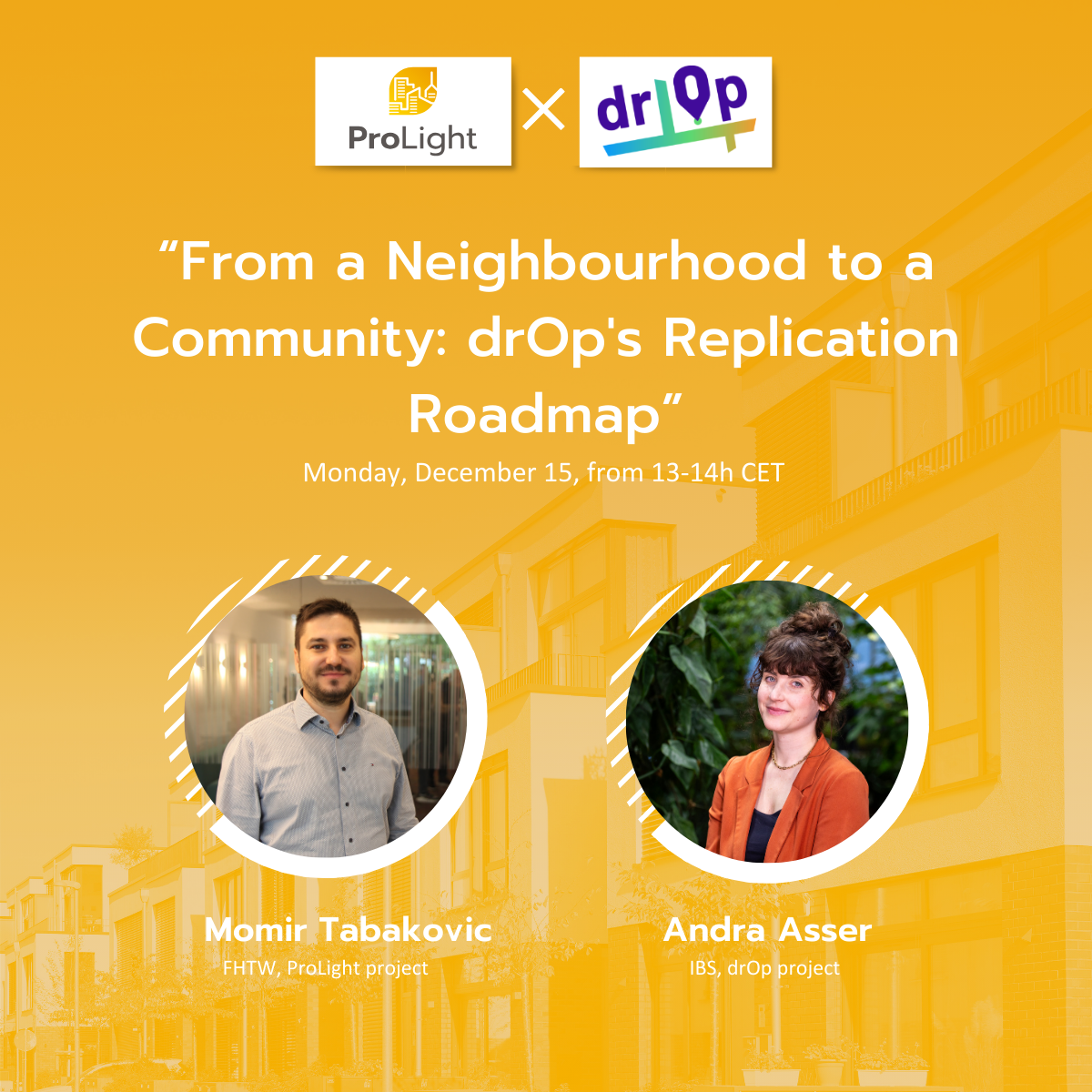
We are pleased to share that drOp has been invited to open the new Lunchtime Knowledge Exchange series hosted by the Horizon Europe project ProLight. This monthly format brings together sister projects working on building renovation, energy communities, and affordable housing to exchange practical insights and strengthen cross-project learning.
In this first session, drOp will present its Replication Roadmap, offering concrete lessons from the transformation of the Santa Ana neighbourhood in Ermua and from the peer cities of Elva and Matera. The discussion is an opportunity to share what we have learned about scaling neighbourhood-level renovation approaches — from co-governance to local economic development — and explore synergies with other European initiatives.
Across Europe, thousands of social housing districts built during the post-war decades are entering a critical moment. Ageing buildings, low energy performance, accessibility barriers, limited public spaces and fragmented communities intersect to create complex environmental and social challenges. Renovating these areas is no longer just about insulation or installing new systems: it is about strengthening social cohesion, unlocking local economic potential and ensuring that the green transition benefits people in their everyday lives. The Horizon Europe project drOp – Digitally enabled social district renovation processes set out to show how this can happen at neighbourhood scale, even without the leverage of a major renovation budget. It demonstrated that when residents, municipalities and innovators work together intentionally, district renovation becomes not only feasible, but genuinely transformative. As Europe prepares to launch the European Affordable Housing Plan on 16 December, drOp’s lessons arrive at a particularly timely moment for policymakers and practitioners alike.
At the centre of drOp is the Integrated Renovation Methodology (IRM), a structured yet flexible framework designed to guide cities through the full cycle of neighbourhood transformation. The IRM brings together three pillars that too often operate in isolation: social innovation and co-governance, urban and technical improvement, and local economic development. Rather than prescribing a fixed sequence, the IRM offers a pathway that can be adapted to local circumstances, allowing cities to enter at different stages depending on their needs. Municipalities can, for example, begin by engaging residents in diagnosis without immediately planning major works, or use the local economic development tools to identify opportunities for skills and entrepreneurship even when technical planning is already underway. drOp thus provides not a rigid blueprint, but a method that acknowledges how much neighbourhood transformation depends on trust, participation and locally grounded potential.
This methodology emerged through close collaboration between three different cities. Ermua (Spain), the demonstration site, applied the method in the Santa Ana neighbourhood, providing real-life feedback on what works and what requires adjustment. Matera (Italy), drawing on its European Capital of Culture 2019 experience, contributed deep knowledge on culture-driven participation, identity-building and creative community activation. Elva (Estonia), recognised for its digital governance, shared tools and expertise on how data and digital public services can enhance transparency, engagement and planning. Together, they shaped a methodology that is immediately recognisable to cities across Europe because it reflects the diversity of their realities and strengths.
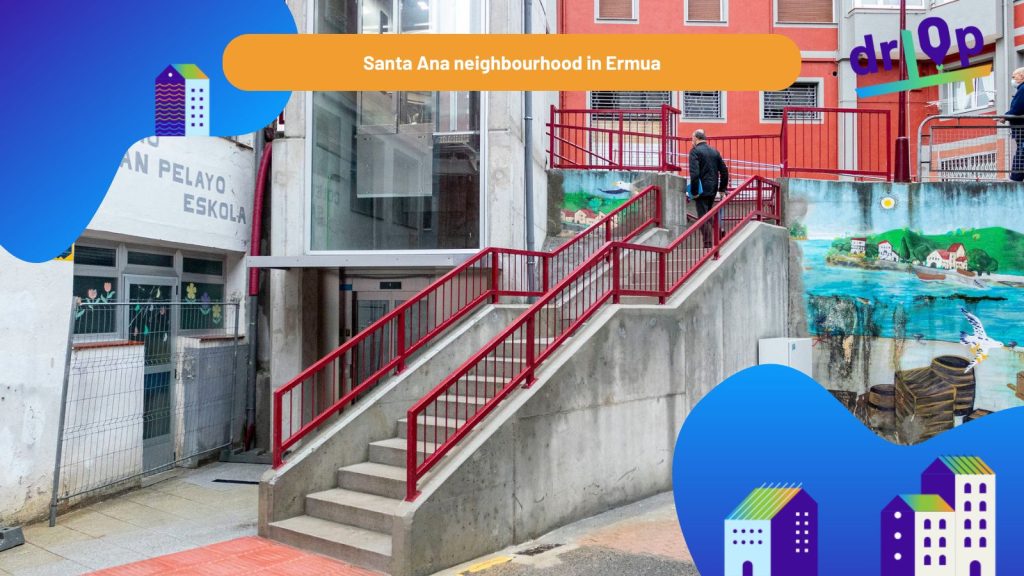
This collaborative approach became most visible in Santa Ana, the neighbourhood where drOp’s ideas materialised on the ground. Built rapidly in the 1960s and 1970s to accommodate a dramatic population increase, Santa Ana grew without a comprehensive urban plan, resulting in deteriorated public spaces, accessibility challenges, and a lingering sense of neglect among residents.
Generally, the interventions carried out by the drOp project were meant to address digitalisation, energy efficiency, public spaces and social cohesion, as a way to improve the overall quality of life for residents. A Local Task Force, bringing together residents, associations, municipal staff and specialists, became the backbone of the governance model, meeting regularly to shape the neighbourhood’s vision, prioritise interventions and monitor progress.
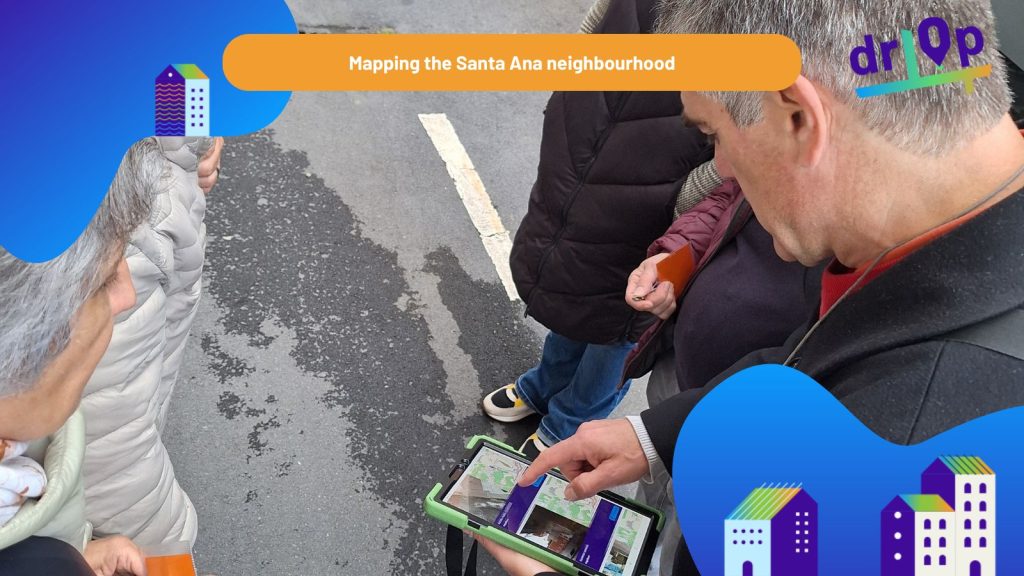
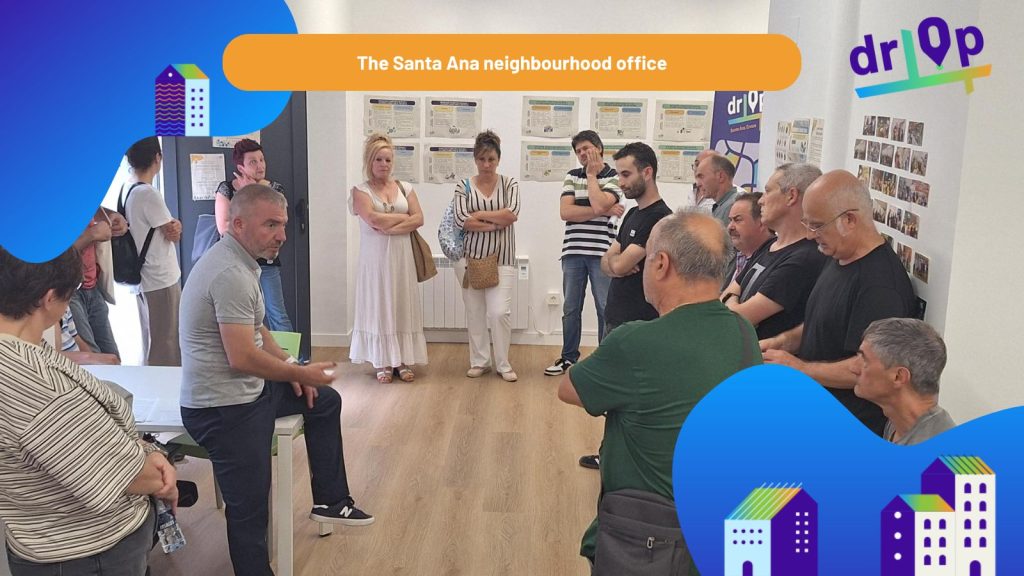
One of the first major steps was the Mapathon, an interactive mapping walk supported by a simple digital tool. Residents walked through Santa Ana identifying accessibility barriers, safety concerns, minor maintenance issues and underused spaces. For many, it was the first time they explored their neighbourhood with a positive attitude and the intention to improve it. The municipality resolved several of the minor issues quickly, reinforcing the message that participation leads to tangible outcomes. The establishment of a Neighbourhood Office soon followed. Strategically located at the heart of Santa Ana, the office offered energy bill advice, information on rehabilitation issues and a continuous presence of the drOp team. In a neighbourhood where trust had eroded over time, the office became an essential anchor, turning an abstract project into something visible and accessible.
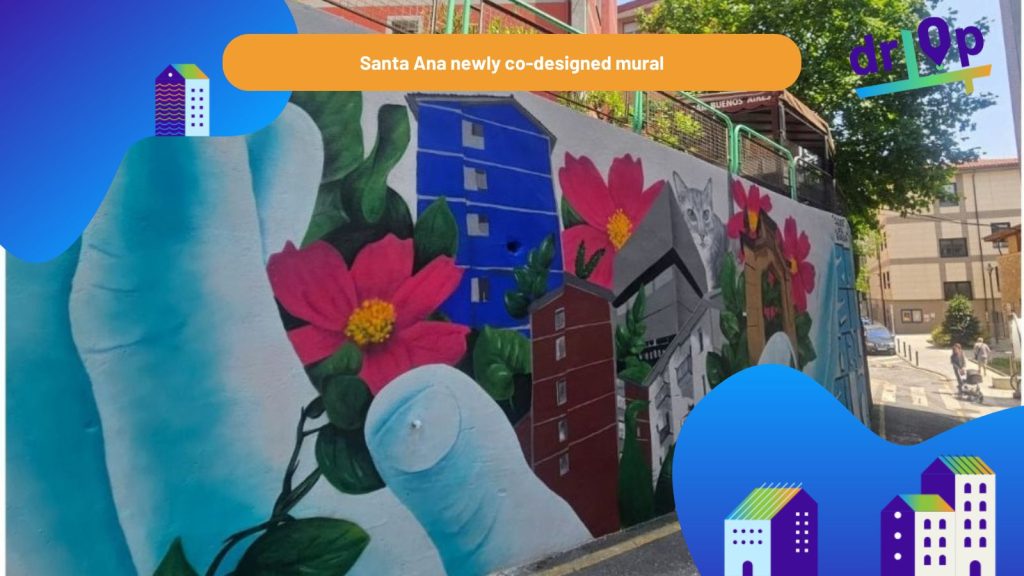
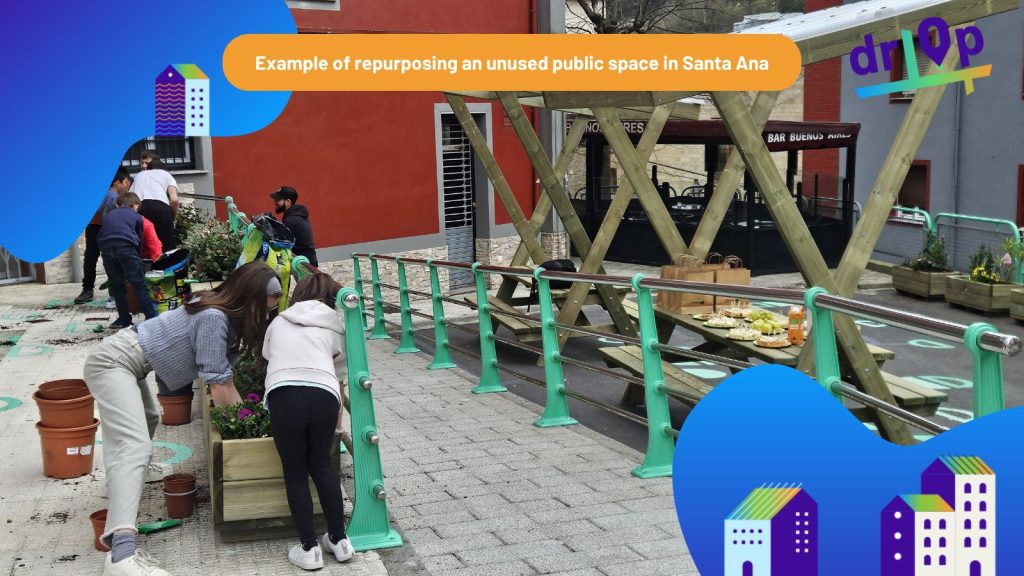
Over time, Santa Ana evolved into a testing ground for ten co-created actions. A former dead-end parking area became the focus of a tactical urbanismexperiment — a temporary, low-cost transformation of public space used to test ideas before any permanent decisions are taken. Through light interventions such as seating, greenery and pedestrian-friendly layouts, neighbours were able to observe how different uses changed the dynamics of the space. A worn-out façade was transformed into a community-selected mural, chosen through a public vote among designs proposed by local artists, turning a neglected party wall into a symbol of shared identity. An architecture competition invited professionals to reinterpret a central square based on priorities defined during resident workshops, reinforcing the connection between urban design and local values.
Complementing these urban interventions, drOp invested in people. A certified training programme on energy-efficient construction enabled residents to acquire new skills that may lead to future employment opportunities. In total, 8 students completed the course, illustrating how renovation can also support local economic development. One of the most innovative actions was the creation of EkiElkar, the Santa Ana energy community, which brings together households, a local school and local businesses around shared solar energy production. drOp supported the legal, technical and administrative setup, while the long-term governance will rest with local members. In parallel, a pilot on digital health services helped senior residents access tools that support independence, safety and wellbeing, reinforcing the principle that neighbourhood transformation includes social infrastructure, not just buildings. Finally, the neighbourhood hosted its first Santa Ana Energy Day, a community event showcasing the possibilities of local renewable energy, giving residents a chance to learn about EkiElkar, engage with experts and celebrate the neighbourhood’s progress toward a more sustainable future.
These combined efforts produced meaningful social impact. Over 130 residents actively participated in co-creation activities, many for the first time. Workshop participation, Mapathon attendance and festival involvement attest to a growing local mobilisation. The Mapathon alone brought together a significant number of participants, while the Neighbourhood Office registered a steady flow of consultations throughout the project. Networks strengthened, local confidence increased and residents began shifting from an individual to a collective vision of their neighbourhood’s future. Participation became more natural, and residents increasingly saw themselves as co-authors of change rather than passive beneficiaries. This cultural shift is one of the project’s most important legacies.
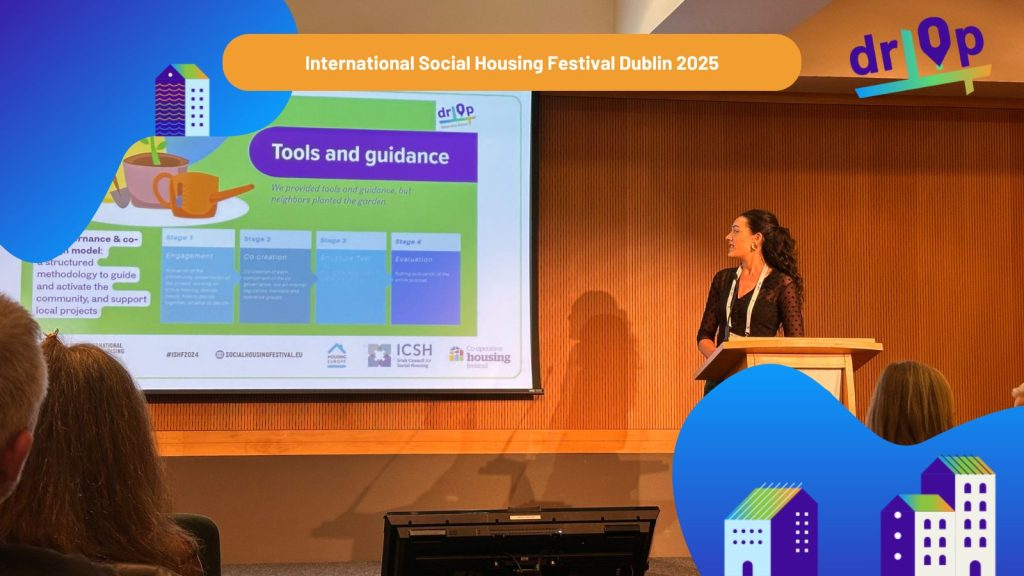
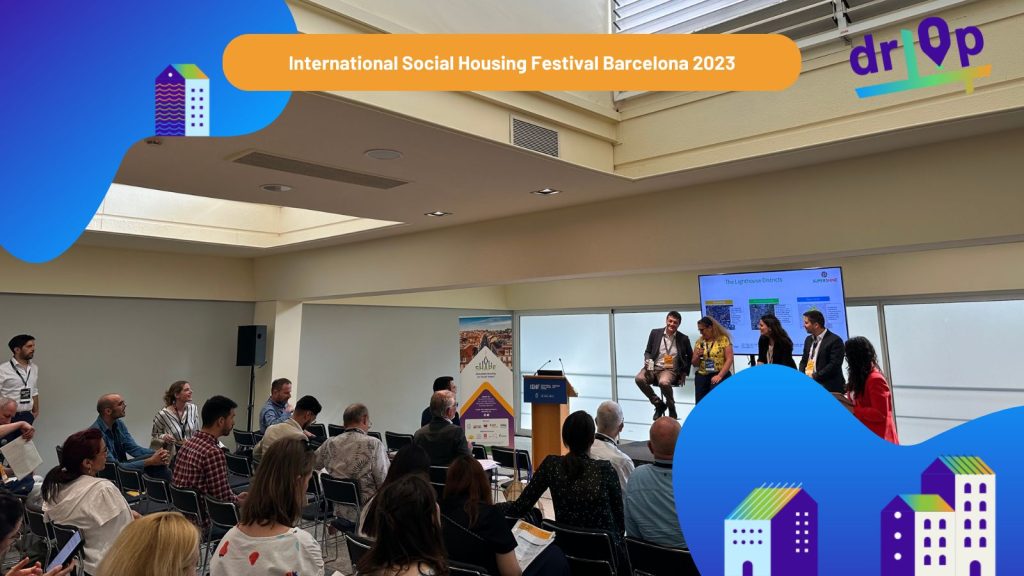
While Ermua led implementation, Elva and Matera played a crucial role in refining the methodology through a structured peer-learning process. Study visits, mentoring sessions and workshops allowed each city to share insights, question assumptions and adapt lessons to their own contexts. drOp also collaborated with its sister projects ProLight and SUPERSHINE, all operating under the wider umbrella of the Affordable Housing Initiative (AHI). Another important partners project was the overarching Affordable Housing Initiative European Partnership. Each project focuses on a specific dimension of district renovation, but they share the overarching goal of renovating neighbourhoods in a socially inclusive, community-driven and environmentally sustainable way. Joint sessions at the International Social Housing Festival in 2023 and 2025 helped exchange early findings and explore how Europe’s neighbourhoods can become laboratories of the green and just transition.
One of the main outputs of this collaborative approach is the Replication Roadmap, a practical guide enabling cities to apply drOp’s approach in full or selectively. Its modular structure allows municipalities to use individual components — such as diagnosis, engagement, co-governance or evaluation — without running through the entire methodology. drOp also leaves behind a Co-Governance Framework, detailing how to structure resident participation; a Local Economic Development Toolkit, based on human-centred business modelling; and Peer City Strategic Plans from Matera and Elva illustrating how different contexts adapt the same principles. Taken together, these resources form an actionable toolbox for any city seeking to build socially driven, economically grounded and technologically enabled renovation pathways.
drOp’s findings are particularly relevant in the current European policy context. The forthcoming European Affordable Housing Plan aims to accelerate renovation, address the needs of vulnerable households and strengthen local governance. drOp contributes concrete examples of how non-financial barriers — such as trust, coordination, participation capacity and the integration of social and economic dimensions — can be addressed effectively. Its lessons support the implementation of the Social Climate Fund, the Cohesion Policy, the Energy Performance of Buildings Directive, and the values of the New European Bauhaus, which emphasise sustainability, inclusion and aesthetics. In Santa Ana, for example, sustainability is expressed through the energy community, inclusion through co-governance and community care, and aesthetics through the mural and tactical urbanism experiment — illustrating how NEB principles can be embedded in everyday local action.
Several insights stand out from drOp’s journey. Trust proved to be the foundation for all subsequent steps. Engagement had to be intentional, visible and consistent, requiring a continuous presence and the willingness to translate early input into early action. Sharing power with residents created shared responsibility and smoother implementation. Bureaucratic and legal barriers emerged as real constraints, showing that innovative ideas need an enabling environment to flourish. Culture, creativity and digital tools were not empty additions but powerful drivers of identity, participation and transparency. Finally, the neighbourhood scale revealed itself as the right scale for linking climate objectives with social outcomes: close enough for meaningful participation, yet large enough to generate measurable impact.
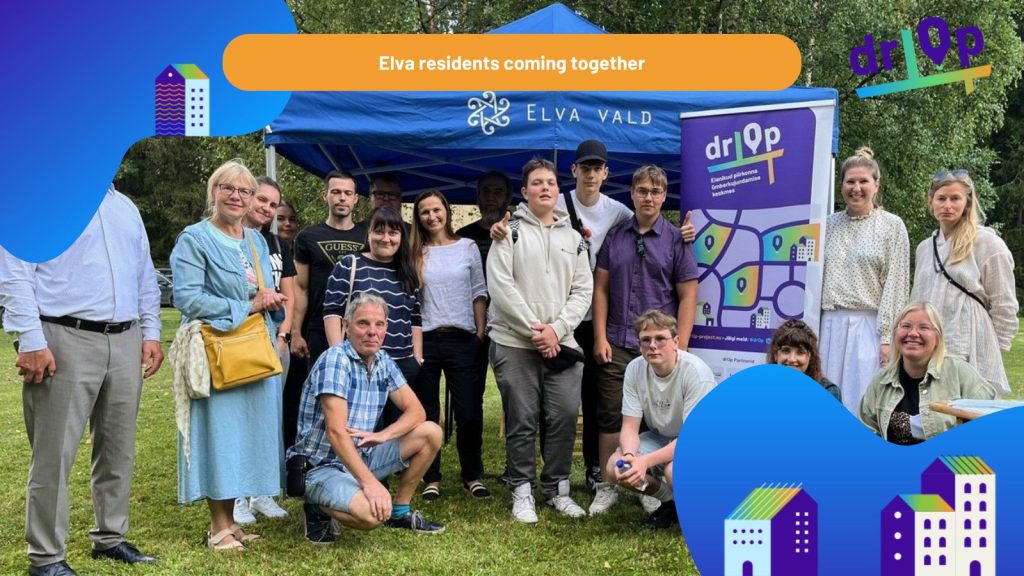
Representatives from Ermua, Matera and Elva came together for a final conversationreflecting on drOp’s journey and the changes it sparked locally. The discussion highlighted how differently each city had entered the project, yet how much they benefitted from working side by side. Ermua emphasised how intentional engagement and small but visible actions had gradually built trust in Santa Ana, even without a renovation budget. Matera underlined the value of cultural and creative approaches in strengthening identity and participation, while Elva noted how digital tools and data-driven planning helped make neighbourhood needs more visible and actionable. All three cities pointed to moments that surprised them — from residents taking ownership of the process earlier than expected to the unexpected connections formed between local actors who seldom collaborated before. Their reflections underscore how adaptable the Integrated Renovation Methodology can be, and how peer learning accelerates progress when cities face similar challenges from different starting points.
As drOp concludes, it leaves behind more than a set of reports. It leaves a method, a community of practice and a belief that renovation can be collective, creative and rooted in local reality. From murals to mapathons, from energy communities to revived festivals, drOp shows how small, intentional actions can create the conditions for long-term transformation. At a time when Europe is redefining its housing agenda, the project offers a clear message: neighbourhoods change when people change them together — one action, one collaboration, one drop at a time.
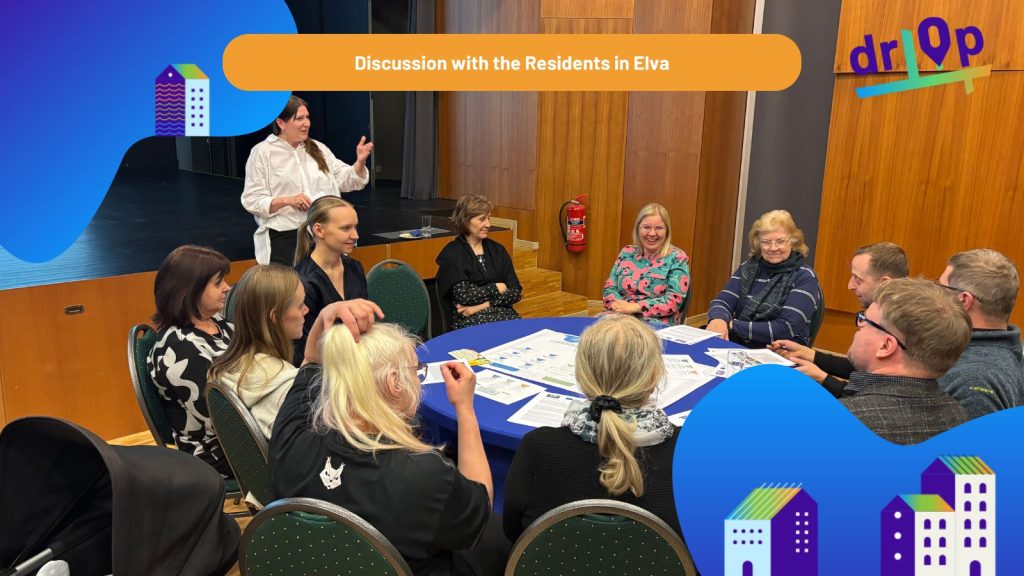
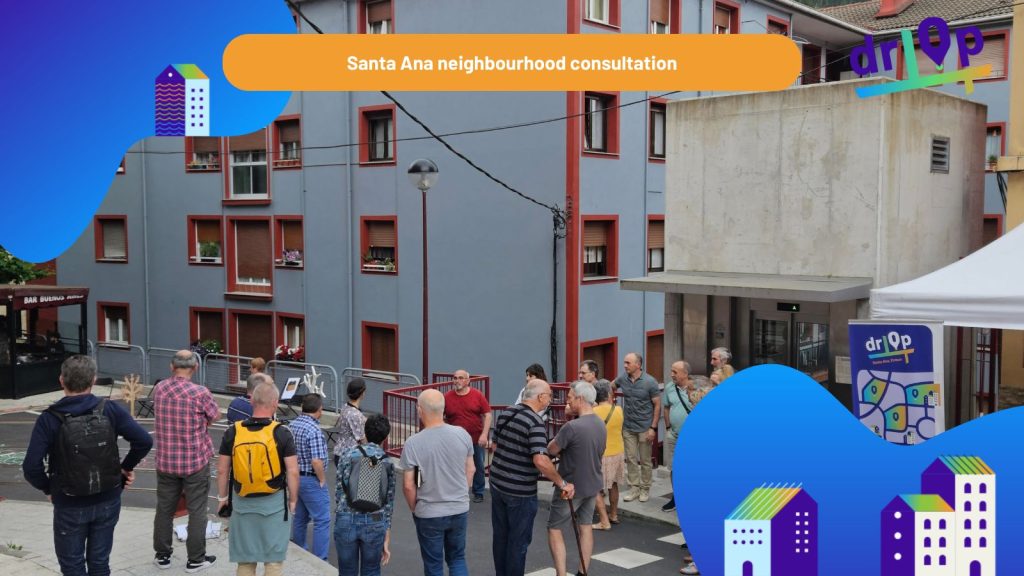
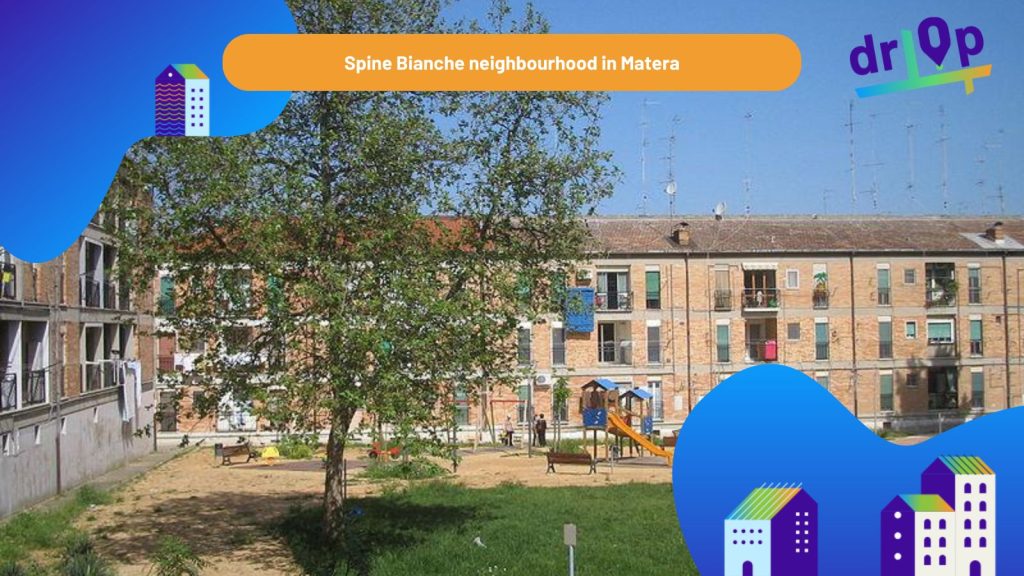
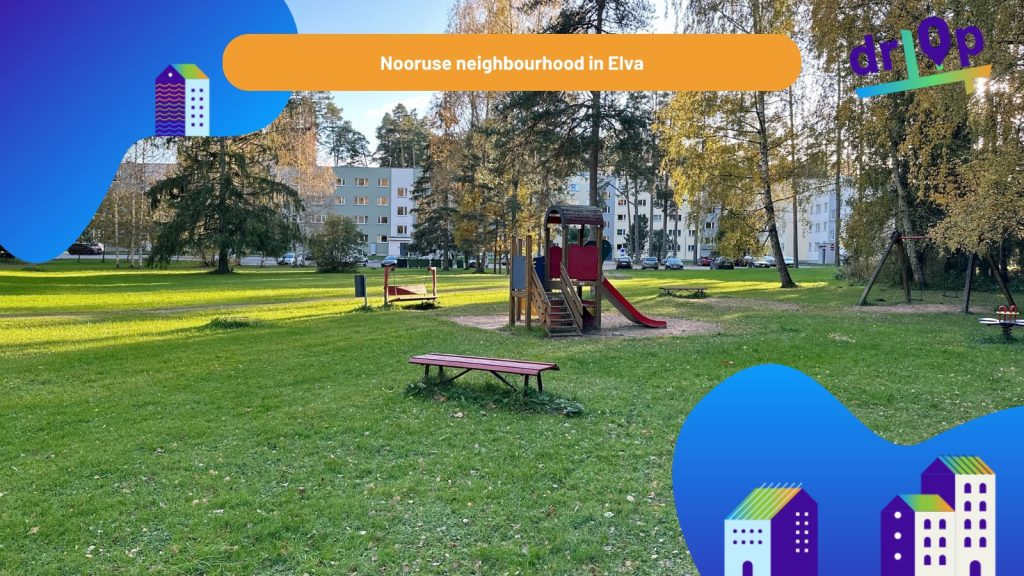
International Social Housing Festival 2025Santa Ana Energy DayMapathonSanta Ana muralNeighbours of Nooruse, ElvaTactical urbanism Santa AnaInternational Social Housing Festival 2023Consultation with residents ElvaSanta Ana neighbourhood officeResidents consultation Santa AnaSpine Biance, MateraNooruse, ElvaSanta Ana, Ermua
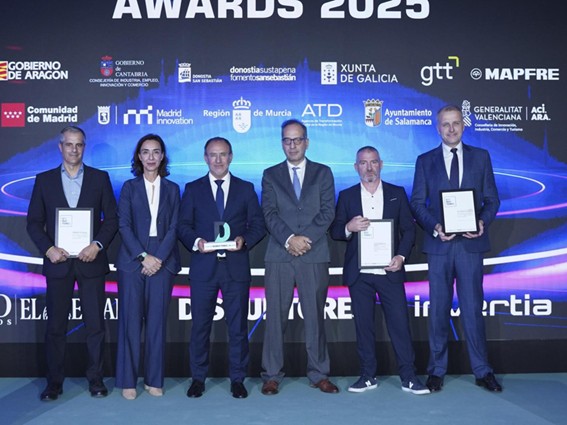
The Municipality of Ermua has been selected as a finalist in the Disruptores Innovation Awards 2025 thanks to the European drOp project. This distinction places drOp among the 50 most disruptive projects of 2025, featured in the prestigious “50+ Disruptors” yearbook, a leading publication in the field of innovation and digital transformation in Spain.
The award ceremony took place on 23 October at the Palacio de Neptuno in Madrid, bringing together key actors from the innovation ecosystem: entrepreneurs, public administrations, startups, technology centres and major corporations. drOp was recognised in the Best Public Project category, further positioning Ermua as a national reference in urban innovation.
Funded by the European Commission, drOp aims to transform social housing neighbourhoods into smart, sustainable and inclusive environments. Piloted in Santa Ana (Ermua), the project integrates urban renewal, energy efficiency, digitalisation and citizen participation through an innovative methodology that actively involves residents and local stakeholders in co-creating solutions. Key actions include the creation of an energy community, digital services for seniors, and public space interventions developed through various participatory processes.
The drOp consortium warmly welcomes this inclusion in the “50+ Disruptors” yearbook, alongside other standout initiatives shaping the future of innovation and digital transformation. It represents a recognition of the collective effort taking place in Santa Ana, demonstrating how local, community-driven initiatives can spark meaningful change.
As the drOp project comes to an end, the three peer cities — Ermua, Elva and Matera — shared their reflections on what it means to apply the Integrated Renovation Methodology in real neighbourhoods. A final recorded discussion with Ermua and Elva is now available, complemented by Matera’s written contribution.
Over the past three years, Ermua, Elva and Matera have worked together to test and adapt the drOp approach to neighbourhood-scale renovation. This final exchange captures what they learned by working directly with residents, experimenting with co-governance, and navigating different political and social contexts.
In the recorded conversation, Ermua and Elva describe how they adapted the co-governance model to fit their neighbourhoods. Although the methodology was designed with commissions and formal structures, both cities quickly realised that effective participation required something much simpler and more flexible. Trust was built gradually — through small, early interventions, consistent communication, and activities that met residents “where they were,” from street events to informal on-site meetings.
Matera echoed this insight. What mattered most was not the formal model itself, but the relationship built between the municipality and residents: listening before planning, allowing participation to unfold naturally, and understanding the cultural and institutional rhythms of the place. Their contribution highlights how even small interactions — a conversation in a square, an impromptu “memory archive” created by older residents — can anchor regeneration in local identity.
Across all three cities, several common lessons emerged:
Start simple: a diagnosis and early listening exercises are essential foundations.
Build trust visibly: small wins matter just as much as long-term plans.
Adapt the model: governance structures, communication tools and digital solutions must respond to local habits, skills and expectations.
Political continuity is key: bottom-up engagement thrives when institutional support remains stable.
Experiment often: tactical urbanism and temporary interventions help test ideas before committing to permanent change.
Although each city applied drOp differently, they all agree on one shared message: meaningful neighbourhood renovation requires patience, openness, and a willingness to experiment — both for municipalities and for communities.
🎥 Watch the recording below to hear directly from the cities who helped shape and test the drOp methodology – and to get inspiration for your own neighbourhood-scale renovation process.
At the Affordable Housing Initiative Days in Prague, the drOp project took centre stage as a story of what can happen when a neighbourhood is given the space, tools, and trust to reinvent itself.
Speaking on behalf of Housing Europe and the project consortium, Andreea Nacu shared the journey of Santa Ana, a small neighbourhood in Ermua (Basque Country) that became a testing ground for a new way of approaching renovation, namely the Integrated Renovation Methodology (IRM).
A neighbourhood shaped by urgency — and full of potential
Santa Ana’s history is one of speed. In the 1960s and 70s, Ermua experienced an extraordinary boom, with its population growing by almost 700% in just a few years during the peak of indistrialisation. Housing had to be built fast, and Santa Ana rose quickly on the hillside, without the time or space for thoughtful urban planning.
Today, those hurried decisions are still visible: steep slopes, narrow paths, very little greenery, low energy performance, and an ageing population who navigates these challenges daily. Local shops have slowly disappeared, and public space doesn’t always invite people to linger.
And yet, Santa Ana is also a neighbourhood full of memories, stories, and strong community ties. This combination of challenges and potential made it the perfect place to test a different approach — renovation that doesn’t start with buildings, but with people.
A methodology built with, not for, residents
The heart of the drOp project is the Integrated Renovation Methodology (IRM). Rather than arriving with a ready-made plan, the IRM moves step by step with the community through four stages:
Engage Reaching out, listening, building trust in a place where participation was almost non-existent.
Co-create Working side-by-side with residents to understand what they want their neighbourhood to become.
Test Trying things out, adjusting, learning from experience.
Evaluate Reflecting on what worked and what still needs to evolve.
This is renovation as a shared process — not something done to people, but something built together.
Three years of walking, mapping, imagining and making
When the project began in 2022, the first task was simply to understand Santa Ana in all its dimensions. A comprehensive neighbourhood diagnosis, combining data and residents’ lived experiences, became the foundation for a common conversation.
From there, neighbours joined workshops, street walks, and visioning exercises. A shared picture of Santa Ana 2035 emerged — a neighbourhood that is greener, more accessible, more vibrant, and more connected.
Through this participatory journey, residents prioritised 10 actions, mixing the project’s original ideas with new ones proposed by the community.
Some of the most meaningful actions included:
🌿 A Neighbourhood Office A welcoming space in the heart of Santa Ana, where residents could stop by for information, get help understanding their energy bills, or simply meet one another. It quickly became a symbol of the project’s presence and openness.
📱 The Mapathon Using a tailor-made app, residents walked the streets and mapped everything that didn’t work — and everything that could. Broken pavements, unsafe corners, forgotten spaces. This walk together sparked new ideas and revealed spots that later became transformation sites.
🎨 A party wall that tells a story Residents didn’t want a generic mural. They wanted something that captured who they are. Local artists created proposals, neighbours voted, and together they gave new life to an otherwise anonymous wall.
🟩 Tactical Urbanism One of the mapped spaces was a dead-end parking area near a school and a bar — full of potential. Instead of debating endlessly, the team and residents simply tested. Picnics, games, temporary structures… observing how people used the space and whether the change felt right. A low-risk, high-learning approach.
☀️ An Energy Community To improve energy efficiency and reduce energy bills, the project supported the creation of a local energy community involving residents, small businesses and a nearby school equipped with solar panels. drOp helped set up the legal and technical structure, with the long-term goal of having the community run independently.
What changed?
More than 130 residents have actively participated so far — a remarkable shift in a neighbourhood that had seen very little civic engagement before.
The changes are both visible and intangible:
Visible
new public spaces activated
an energy community legally established
a neighbourhood office that continues to serve residents
capacity-building through training
Intangible but deeply important
a renewed sense of belonging
stronger connections between neighbours
a cultural shift from “my problem” to “our neighbourhood”
trust — fragile, but finally growing
As Andreea stressed in Prague, this is one of the most valuable outcomes: a community that feels it has a say in itsfuture.
Lessons we carry forward
drOp’s journey confirmed that successful neighbourhood renovation is not just technical — it is deeply human. Some of the strongest lessons include:
Trust is the foundation. Without it, even the best plans stay on paper.
Power must be shared. Participation needs to be meaningful, not decorative, and people need to own their responsabilities.
Public spaces are commons. When people feel ownership, they care for them.
Legal frameworks matter. Bureaucracy can slow things more than participation ever will.
Context rules. There is no universal formula — methodologies must adapt to each place and community.
One participant asked: “Without Horizon Europe funding, how do you justify such deep participation?” The answer is simple: Participation is not a cost. It is an investment.
Co-created plans are clearer, more realistic, and more convincing for future funding. They reduce conflict, increase acceptance, and lead to solutions that last. And, perhaps most importantly, they strengthen communities — something no renovation budge
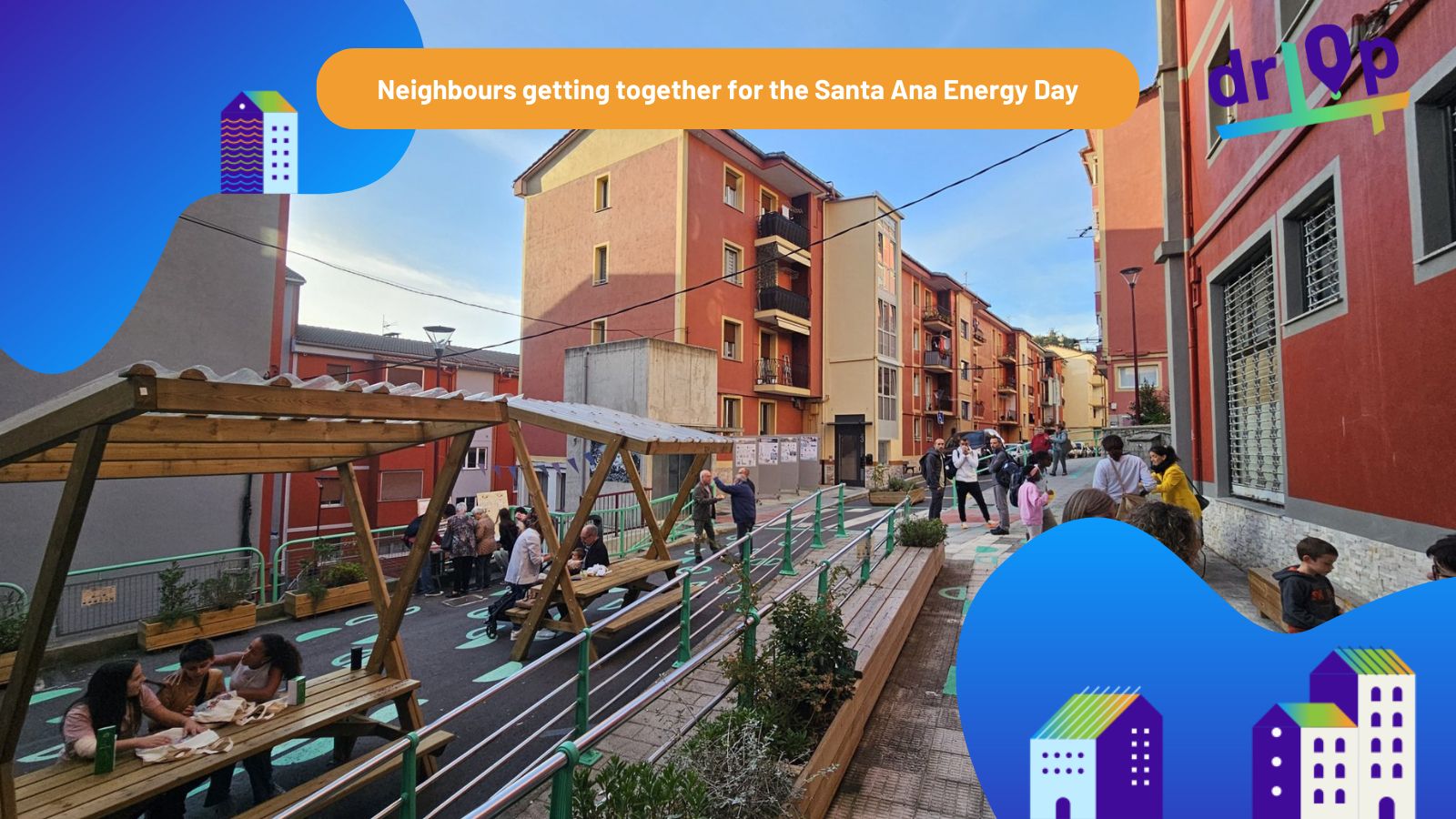
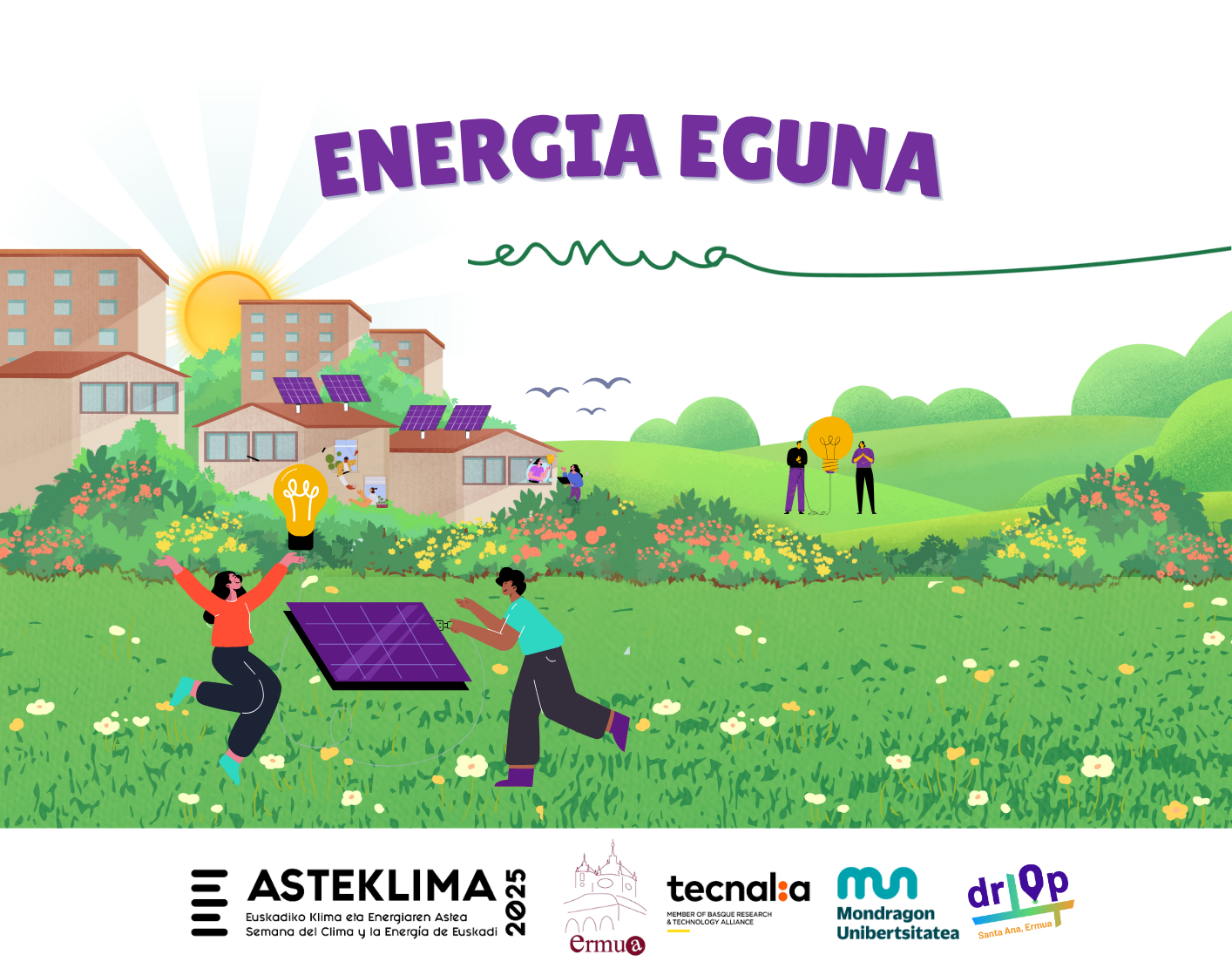
On Friday 24th of October, the Santa Ana neighbourhood became the epicenter of the local energy transition with the celebration of Energy Day, a festive and participatory event organized by the Ermua City Council as part of Asteklima 2025, the Basque Country Climate and Energy Week, and coinciding with the International Day Against Climate Change. The event served to present and promote the recently formed Ekielkar energy community, a project that seeks to make renewable energy a shared reality for residents, local businesses, and the Eskolabarri school.
The event had a clear objective: to promote the conscious and sustainable use of energy, strengthen community ties, and highlight the local commitment to the energy transition. And it did so with a simple but powerful formula: learning by doing, sharing as a community, and demonstrating that small gestures are the beginning of great changes.
Energy Enters the School
The day began at the Eskolabarri school, where 147 primary school students participated in activities to discover how solar energy works and what benefits the energy community brings to the neighborhood and the planet. There was an interactive talk, a practical demonstration with a real-life photovoltaic installation model -which allowed the students to power a lamp and a fan with solar energy- and a collective mural of personal commitments to saving energy at home and at the school. Each student took home a biodegradable notebook with seeds, as a symbol that change also comes from planting.
The Square, a Space for Collective Action
In the afternoon, the pedestrianized Santa Ana Square—a former parking lot transformed through a participatory process and currently in the testing phase—became a point of citizen action for the energy transition.
More than 65 people completed the Energy Passport, a tour of four thematic stands with micro-actions on solar energy, energy savings, responsible consumption, and reducing CO₂ emissions. Each activity was practical and accessible: plugging in cables, sorting habits by consumption, writing CO₂ equivalents, or leaving visible commitments. Because when something is touched and done, learning becomes action.
The day was accompanied by music and an exhibition on the energy transition. Those who completed the energy passport enjoyed a Km0 community snack and received a recycled bag with the image of the mural chosen by the residents, symbolizing the neighborhood’s identity and collective action, along with a reusable metal bottle as a gesture toward responsible consumption.
A day to bring the energy transition closer
The Energy Day was much more than a celebration: it was presented as an example of how collaboration between different stakeholders can drive the energy transition from the local level. The day brought together the Ermua City Council and its drOp project partners, Tecnalia, and Mondragon University, demonstrating that innovation and citizen participation are essential to turning a global challenge into concrete, local actions. It was a diverse, intergenerational gathering that demonstrated that the energy transition can be accessible, practical, and shared. With simple and dynamic activities, the event transformed a global challenge into a local, accessible, and enjoyable experience, where every step counts toward building a more sustainable future.
As part of the programme, drOp EU will showcase its integrated renovation methodology, tested in Ermua (Spain), where housing providers and residents co-designed the transition of social housing districts into inclusive, sustainable neighbourhoods.
Together with the ARV project and other AHI pioneers, drOp will demonstrate how district-level approaches can accelerate the green and social transition of Europe’s ageing housing stock.
Full programme
18 November 2025, Grandior Hotel Prague 1052/42 Na Poříčí 110 00 Praha 1 Czechia
09:00 – Official Welcome Marco Corradi, President, Housing Europe Miriam Bellušová, Board Member, European Building Confederation
09:15 – Setting the Stage Joao Goncalves (Housing Europe)
09:20 – Keynote: The Swedish experience. Ensuring Affordability at Scale Insights and lessons from Sweden’s decades-long approach to housing policy, financing and management. Current problems and ongoing responses.
Marten Lilja (Housing Expert)
09:35 – Panel: Recent Renovation Practices of Large Housing Estates in Baltic, Central and Eastern European countries A deep dive into practical experiences, challenges, and latest outcomes from renovating large housing blocks and districts across the Baltic and CEE region.
Moderator: João Gonçalves (Housing Europe)
Panelists: Anu Sarnet (Estonian Union of Co-Operative Housing Associations, EKYL) Jana Kubankova (Czech Chamber of Architects) Martha Giannakopoulou (European Urban Initiative Expert)
Q&A with the audience
Networking Coffee Break
10:30 – Lighthouse District #1: The Karvina Project – the ARV holistic approach in Czechia A concrete example of a holistic district renovation developed in the city of Karvina by the “ARV” partnership, which showcases the integration of energy, social, and community improvements.
Robert Wawerka (Czech Technical University in Prague) Michael Sikora (City of Karvina)
10:45 – Lighthouse District #2: Ermua – the drOp lab for building trust with residents In Ermua (Spain) the “Drop” consortium developed and tested their integrated renovation methodology aiming to transform social housing districts into inclusive sustainable neighbourhoods.
Andreea Nacu (Housing Europe)
11:00 – Fireside Chat: What Is Lacking at the Local Level to Bring About the Desired Projects An informal discussion on the needs and critical gaps the Affordable Housing Initiative pioneers are facing in their pathway to deliver successful holistic projects.
Moderator:Margherita Marinelli, Housing Europe
Panelists:
Franco Amigoni (Town of Fidenza) David McCourt (Cooperative Housing Ireland) Viktor Riabokin (City of Kiev)
Networking Coffee Break
11:45 – Response from the stakeholders: breaking down barriers to scaling up Their response to the policy, financial, and technical hurdles identified and faced by local promoters.
Panelists:
Matthew Baldwin (European Commission’s Housing Task Force) Miriam Bellušová (Slovak Association of Construction Entrepreneurs) Bernd Riesland (Austrian Federation of Limited-Profit Housing Associations) Michael Sikora (City of Karvina) Angeliki Konstantinopoulou (Sustainable Energy Finance Association)
12:30 – Interactive Q&A An open forum for the audience to ask questions to the stakeholders.
12:45 – Takeaways and Closing Remarks Sorcha Edwards (Housing Europe)
The day will continue with a pitching session which is invitation-only.
Pioneers pitch projects to investors and financial experts
Hotel Grandior, Conference Room and Classroom
14:00 – Welcome and rule setting
14:10 – Presentation from pioneers, feedback, and Q&A
17:00 – Conclusion
The AHI Days are the opportunities to showcase great examples from the sector and elicit discussion across the board on the ways to expand those. The programme is quite multifaceted to accommodate different learning and networking opportunities, encompassing workshops and seminars (open to the public), study visits, and one-on-one organised meetings between practitioners (1 on 1). The events are organised across Europe in Dublin (June 4th and 5th 2025), Prague (November 18th and 19th 2025) and a city to be confirmed (June 2026).
The town of Ermua celebrates its first Energia Eguna (Energy Day) — a community-driven event organised by the Ermua City Council to mark the creation of the Ekielkar energy community in the Santa Ana neighbourhood, developed within the framework of the EU-funded project drOp.
This festive day promotes conscious and sustainable energy use, strengthens community ties, and showcases local commitment to the Sustainable Development Goals. Activities throughout the day will engage residents of all ages — from school workshops on energy saving to citizen “micro-actions” that turn learning into collective impact.
These short, accessible activities empower people to take part in the energy transition in tangible, everyday ways — proving that local action can spark wider change.
💡 Curious to see how it goes? Would you like to organise something similar in your own city or neighbourhood?
👉 Get in touch with us to learn more about how drOp supports local energy communities across Europe.