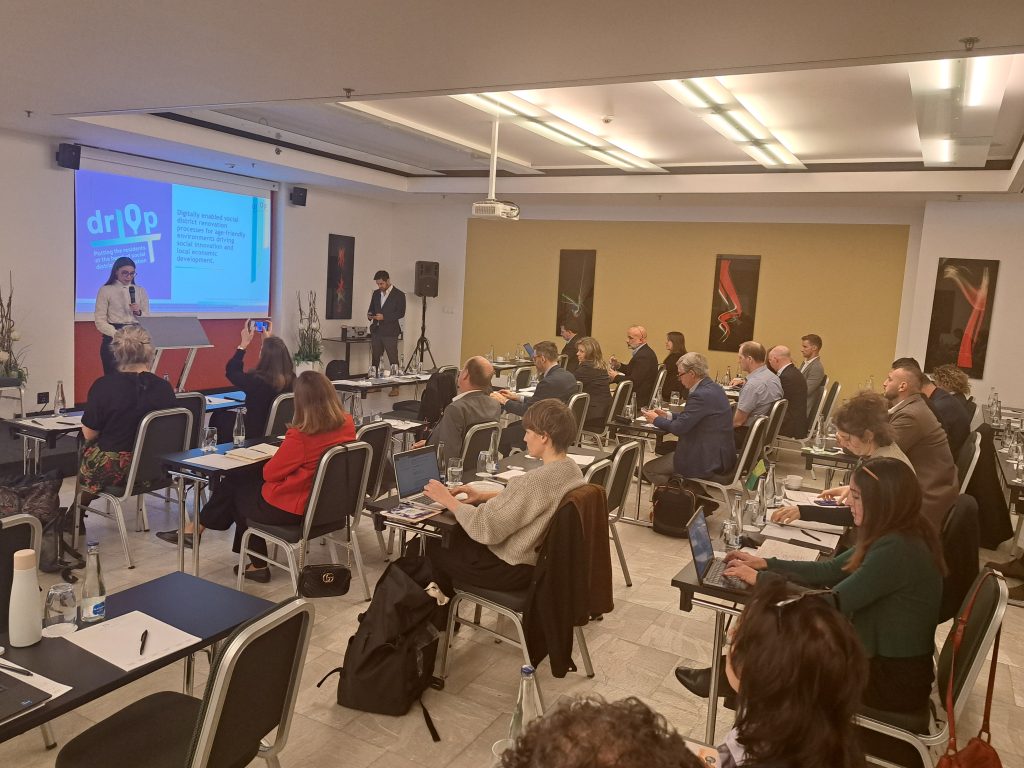
On June 4th, during the International Social Housing Festival (ISHF) in Dublin, Housing Europe and its partners hosted the final conference of the EU-funded drOp project. The event brought together social housing providers, municipalities, researchers, and community stakeholders to examine how integrated approaches can revitalise neighbourhoods across Europe. This article covers the final conference of the project, marking the culmination of its multi-year journey and pilot implementations across Europe.
The session, titled “How can social housing districts become vibrant, inclusive neighbourhoods?”, blended strategic insights with hands-on experiences, highlighting the impact of culture, citizen participation, digital tools, and local economic development.
Bent Madsen, President of Housing Europe, set the tone: “Renovation is not just about insulation—it’s about health, education, and well-being.” He highlighted the Danish Aalborg model as a successful example of tenant-led transformation.
Matthew Baldwin, leading the European Commission’s Housing Taskforce, presented the Affordable Housing Initiative, rooted in social housing best practices. He underscored the need for capacity-building and collaboration between public, cooperative, and private actors.
The spotlight then turned to the drOp methodology, presented by Silvia Urra Uriarte (Tecnalia). It is an integrated renovation model based on co-diagnosis, co-design, and co-implementation, reinforced by a 5P multistakeholder governance approach involving residents, municipalities, civil society, startups, and academia.
From across Europe, peer cities shared their applications:
- In Matera, Italy, Carlo Feretti (Materahub) detailed how a history of cultural placemaking inspired a co-governance model allowing citizens to shape their neighbourhoods through local task forces.
- Riccardo Coletta (APRE) and Dr. Paola Zerilli (University of York) highlighted the SUPERSHINE project, which pilots innovative PPPs for energy renovations in Italy, Denmark, and Latvia, demonstrating that social and environmental goals can align with financial feasibility.
- Representing Housing Europe member Legacoop Abitanti, Rossana Zaccaria showcased how housing cooperatives are innovating through community libraries, artistic initiatives, and renewable energy hubs—redefining urban regeneration with a cooperative spirit.
- From Ermua, Spain, Marta Lekue shared how a disused garden space became a vibrant symbol of resident-led change, engaging over 130 neighbours in local action.
- Jaanika Saar and Sirli Pippar (Elva, Estonia) presented the Nooruse neighbourhood pilot. Digital surveys, participatory budgeting, and citizen outreach—anchored by trusted community figures or “spark persons”—were central to its success.
- Graziella Roccella (Planet Smart City) introduced the Citizen Lab model, showing how gamification and data feedback loops support behavioural change and digital inclusion in housing communities.
- Patricia Astorgano (Codema – Dublin’s Energy Agency) presented Codema’s contribution to the REGEN project, focusing on how digital tools can deepen citizen engagement in energy-oriented renovation processes.
Together, these contributions reflected the drOp project’s core aim: to turn social housing districts into smart, inclusive neighbourhoods where residents are not just recipients of change—but co-creators of it.
Have a look below at what our speakers presented, and do not hesitate to get in touch.
For more on citizen engagement, local economic development, culture, and digital innovation in neighbourhood regeneration, subscribe to the drOp newsletter.