Archives: News

  • Replication Roadmap for Urban Regeneration in Europe

    Replication Roadmap for Urban Regeneration in Europe

    On 23 September 2025, the drOp project hosted its fith webinar, “From Neighbourhood to Community: Lessons from European Cities District Regeneration.” The session brought together partners and cities to reflect on three years of work and, most importantly, to discuss how these lessons can be replicated across Europe.

    Why replication matters

    Opening the event, Andreea Nacu (Housing Europe) underlined that drOp’s mission is to help neighbourhoods — often built decades ago — transform into inclusive, sustainable, accessible, and connected places. Pilots are inspiring, she noted, but for real impact, their methods must be adapted and scaled in different contexts.

    The Integrated Renovation Methodology (IRM)

    Silvia Urra (Tecnalia) presented the project’s conceptual backbone: the Integrated Renovation Methodology (IRM). Designed as a co-creation process, IRM combines social innovation, local economic development, housing renovation, and energy communities. Its three levels — strategic, design, and intervention — guide cities from diagnosis and visioning to action planning and implementation.

    Ermua: Santa Ana neighbourhood

    Marta Lekue (Municipality of Ermua) shared how the Basque town piloted IRM in the Santa Ana neighbourhood, built in the 1960s–70s. Residents co-created a Neighbourhood Vision 2035 and implemented actions such as:

    • A Neighbourhood Office as a hub for information and participation.
    • A Mapathon to identify local issues and opportunities.
    • Tactical urbanism to test new uses of public space.
    • A community-designed mural celebrating local identity.
    • An Energy Community bringing together residents, businesses, and schools.

    More than 130 people were directly involved, leading to tangible urban improvements and a stronger sense of belonging and participation.

    Elva: Nooruse neighbourhood

    From Estonia, Sirli Pippar (Elva Municipality) presented the regeneration of Nooruse neighbourhood. Starting from poor physical conditions, Elva engaged residents through workshops and co-creation, building trust step by step. Adaptations were essential: simplifying governance tools, focusing on small visible changes, and prioritising face-to-face engagement. By the end, residents had developed a Community Action Plan, a spatial plan, and even proposed a project for the participatory budget.

    Replication roadmap

    Finally, Andra Asser (Institute of Baltic Studies) introduced the Replication Roadmap. Rather than a technical report, it is a practical guide for municipalities, including methodologies, case studies, and lessons learned. Key insights include:

    • The importance of combining data with a “personal touch” in neighbourhood analysis.
    • The value of a local hub such as a Neighbourhood Office.
    • Simplification as a way to increase participation.
    • The role of trusted community figures as “anchors” for engagement.

    Looking ahead

    The session concluded with a strong message: replication is not copying, but adapting. Each city has its own history, culture, and challenges — but with the right tools, the lessons of drOp can inspire transformation well beyond the pilot sites.

    The Replication Roadmap will soon be published and made available on the drOp website.

    In the meantime, we invite you to watch the recording, study the presentations, and ask our speakers questions⚡

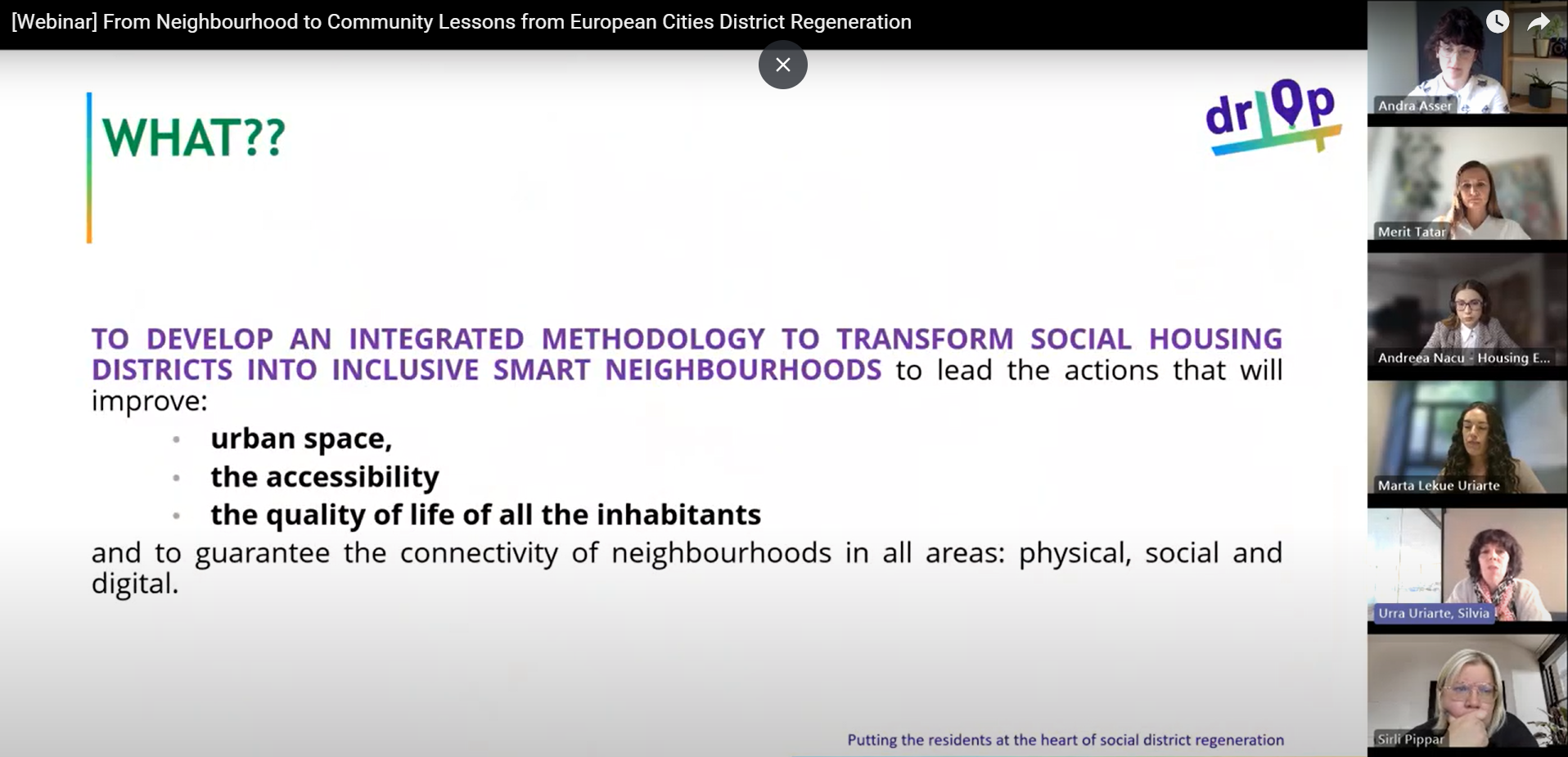
  • [Webinar] From Neighbourhood to Community: Lessons from European Cities District Regeneration  

    [Webinar] From Neighbourhood to Community: Lessons from European Cities District Regeneration  

    This session will bring together the key insights from the drOp EU project’s experience, highlighting the main lessons drawn from working with urban communities in neighbourhood regeneration processes. The discussion will reflect on opportunities and challenges faced by municipalities when implementing renovation and urban regeneration approaches. Special attention will be given to the case of Ermua, Spain and Elva, Estonia, offering practical examples and integrated reflections. The session will conclude with recommendations for future replicators, pointing towards a roadmap that supports more effective transfer and scaling of innovative practices across European cities. 

    Agenda

    11:00-11:05 | Introduction – Andreea Nacu, Housing Europe

    11:05-11:15 | drOp Integrated Renovation approach – Silvia Urra Uriarte, Tecnalia

    11:15-11:25 | Ermua case (Spain) – Marta Lekua Uriarte, Ermua Municipality 

    11:25-11:35 | Elva case (Estonia) – Jaanika Saar, Elva Municipality

    11:35-11:50 | Towards Replication: Peer Learning, Insights, and Roadmap – Andra Asser, Institute of Baltic Studies 

    11:50-12:00 | Q & A  

    📅23rd of September

    ⌚11:00-12:00 CET

    📍Online

    ✍🏻Register here.

    Join, listen, ask questions and share the knowledge!

  • [New video] Home & Community: Renewal of Nooruse

    [New video] Home & Community: Renewal of Nooruse

    The Horizon drOp project combines the renovation of residential quarters and their accessibility with innovative digital solutions, social innovation, and local economic development. The goal of the project for Elva is to develop a comprehensive renovation methodology for the Nooruse apartment building area, based on which the area should become a smart “district,” with better urban space quality, accessibility, and quality of life for all residents.

    The new video by the drOp partners in Estonia—Elva Municipality/city of Elva, the Institute of Baltic Studies, and the Estonian Union of Co-operative Housing Associations—will introduce the drOp pilot in Elva city and will give you a glimpse of the Nooruse neighbourhood with the help of the residents.

    The video was filmed by the Estonian Union of Co-operative Housing Associations during a workshop with the residents of the Nooruse neighborhood in August 2025.

  • drOp newsletter – summer 2025 edition

    drOp newsletter – summer 2025 edition

    Discover the latest updates from the drOp project: the launch of EkiElkar, Ermua’s first local energy community, vibrant public space transformations in Santa Ana, and early replication efforts in Elva and Matera. Highlights include participatory urban design, inclusive renovation strategies, and key events like the Final Conference in Dublin.

    Enjouy the read!📰

  • The neighborhood’s small square is being transformed through tactical urbanism

    The neighborhood’s small square is being transformed through tactical urbanism

    The neighborhood’s small square is undergoing an exciting transformation thanks to a tactical urbanism process that has placed residents at the center from the very beginning. Over the past few months, many neighbors have visited the area to actively participate in designing the new space, proposing the features and elements they considered important for their everyday lives.

    At the beginning of the year, the Ermua City Council inaugurated the second temporary design of the square, the result of this participatory process. During the event, attendees had the opportunity to explore the redesigned space and discuss the next steps in its transformation and testing phase.

    One of the most special moments of the day was the participation of students from Eskolabarri School, who helped plant new vegetation in the planters installed throughout the square. In addition, a small lunch was organized where young participants shared their impressions of the new space and their experiences within it.

    With the arrival of good weather, the square has become a gathering place for all generations in the neighborhood. Some enjoy sitting in the sun with a drink—thanks to a nearby bar—while others use the space to knit, chat, and spend time with their neighbors.

    The next step in this exciting process will be to consult the community to decide whether to keep the square as it is now or return it to its previous state. A collective decision to continue building a more livable and shared neighborhood for everyone.

  • The neighborhood’s new mural is now complete!

    The neighborhood’s new mural is now complete!

    The renovation of the neighbourhood mural is now a reality. After several weeks of work and a participatory process, the final design—chosen by local residents through a popular vote—has been brought to life by a local artist from the town.

    The mural, full of symbolism and colour, captures the spirit of the neighbourhood through hands that build and support various buildings representative of the area. With this image, the artist aimed to reflect ideas such as “the neighbourhood in our hands” and “we build the neighborhood with our own hands”—a clear nod to the collective effort and sense of community that defines our streets.

    Plants and natural elements also hold a special place in the mural, as a tribute to the small green spaces lovingly cared for by neighbours.

    The mural not only beautifies the surroundings but also reflects the identity, memory, and shared values of the neighbourhood.

    Stay tuned for more Santa Ana updates🏘️

  • EkiElkar Launches: Ermua’s First Local Energy Community Takes Root in Santa Ana

    EkiElkar Launches: Ermua’s First Local Energy Community Takes Root in Santa Ana

    Ermua, June 25, 2025 – Santa Ana, the pilot neighbourhood of drOp project, has taken a bold step toward sustainability and social innovation with the launch of the Local Energy Community “EkiElkar”. This pioneering initiative is part of the European drOp project, which aims to transform the neighbourhood through five key pillars: enhancing public spaces, boosting the local economy, fostering social innovation, promoting digitalization, and—most notably—advancing energy efficiency.

    In the field of energy, the project has already delivered several impactful actions: vocational training in energy-efficient construction, personalized energy bill assesment at the Neighbourhood Office, educational sessions for residents, and a series of interactive workshops that have guided the community through the process of forming their own Energy Community.

    The result is EkiElkar, a community-driven energy initiative that now includes 45 households, local businesses, and the local Eskolabarri school. At its core is a 40 kWh solar photovoltaic plant, funded by the drOp project, which enables members to consume clean, renewable energy—cutting costs while contributing to decarbonization and local energy resilience.

    The name EkiElkar blends two Basque words: Eki (sun) and Elkar (together), symbolizing the project’s collaborative and sustainable spirit. Beyond its environmental and economic impact, EkiElkar also strengthens community bonds and civic engagement, positioning Santa Ana as a model neighbourhood for urban innovation across Europe.

    The initiative was spearheaded by the Ermua City Council, which provided legal support for the community’s formation, and received technical assistance from drOp project partners Tecnalia and Mondragón University.

    In addition, the project is developing an energy consumption data analysis service, which will allow community members to monitor their energy consumption and savings through periodic personalized reports, thus promoting more conscious and efficient energy management.  Looking ahead, the possibility of expanding the energy community and replicating the model in other neighbourhoods of the municipality will be explored, thus consolidating Santa Ana as a benchmark urban laboratory at the European level.

  • Final Conference of the drOp Project: Showcasing Inclusive Neighbourhood Regeneration at ISHF 2025

    Final Conference of the drOp Project: Showcasing Inclusive Neighbourhood Regeneration at ISHF 2025

    On June 4th, during the International Social Housing Festival (ISHF) in Dublin, Housing Europe and its partners hosted the final conference of the EU-funded drOp project. The event brought together social housing providers, municipalities, researchers, and community stakeholders to examine how integrated approaches can revitalise neighbourhoods across Europe. This article covers the final conference of the project, marking the culmination of its multi-year journey and pilot implementations across Europe.

    The session, titled “How can social housing districts become vibrant, inclusive neighbourhoods?”, blended strategic insights with hands-on experiences, highlighting the impact of culture, citizen participation, digital tools, and local economic development.

    Bent Madsen, President of Housing Europe, set the tone: “Renovation is not just about insulation—it’s about health, education, and well-being.” He highlighted the Danish Aalborg model as a successful example of tenant-led transformation.

    Matthew Baldwin, leading the European Commission’s Housing Taskforce, presented the Affordable Housing Initiative, rooted in social housing best practices. He underscored the need for capacity-building and collaboration between public, cooperative, and private actors.

    The spotlight then turned to the drOp methodology, presented by Silvia Urra Uriarte (Tecnalia). It is an integrated renovation model based on co-diagnosis, co-design, and co-implementation, reinforced by a 5P multistakeholder governance approach involving residents, municipalities, civil society, startups, and academia.

    From across Europe, peer cities shared their applications:

    • In Matera, Italy, Carlo Feretti (Materahub) detailed how a history of cultural placemaking inspired a co-governance model allowing citizens to shape their neighbourhoods through local task forces.
    • Riccardo Coletta (APRE) and Dr. Paola Zerilli (University of York) highlighted the SUPERSHINE project, which pilots innovative PPPs for energy renovations in Italy, Denmark, and Latvia, demonstrating that social and environmental goals can align with financial feasibility.
    • Representing Housing Europe member Legacoop Abitanti, Rossana Zaccaria showcased how housing cooperatives are innovating through community libraries, artistic initiatives, and renewable energy hubs—redefining urban regeneration with a cooperative spirit.
    • From Ermua, Spain, Marta Lekue shared how a disused garden space became a vibrant symbol of resident-led change, engaging over 130 neighbours in local action.
    • Jaanika Saar and Sirli Pippar (Elva, Estonia) presented the Nooruse neighbourhood pilot. Digital surveys, participatory budgeting, and citizen outreach—anchored by trusted community figures or “spark persons”—were central to its success.
    • Graziella Roccella (Planet Smart City) introduced the Citizen Lab model, showing how gamification and data feedback loops support behavioural change and digital inclusion in housing communities.
    • Patricia Astorgano (Codema – Dublin’s Energy Agency) presented Codema’s contribution to the REGEN project, focusing on how digital tools can deepen citizen engagement in energy-oriented renovation processes.

    Together, these contributions reflected the drOp project’s core aim: to turn social housing districts into smart, inclusive neighbourhoods where residents are not just recipients of change—but co-creators of it.

    Have a look below at what our speakers presented, and do not hesitate to get in touch.

    For more on citizen engagement, local economic development, culture, and digital innovation in neighbourhood regeneration, subscribe to the drOp newsletter.

  • ProLight 4th CAPACITY BUILDING WORKSHOP

    ProLight 4th CAPACITY BUILDING WORKSHOP

    📅Tuesday 24th June 2025
    ⌚13:00 – 18:00 CET
    📍Online and at Greenovate! Europe EEIG, located at 231 Avenue Louise, 1050 Brussels

    drOp is happy to be part of this session organised by our sister project ProLight.


    The 4th Capacity Building Workshop (CBWS) of the ProLight project (www.prolight-project.eu) is scheduled for June 24, 2025. The event will take place in person at Greenovate! Europe EEIG, located at 231 Avenue Louise, 1050 Brussels, starting at 13:00, and will also be available online, coordinated by CluBE (Cluster of Bioeconomy and Environment of Western Macedonia). The hybrid format of the workshop will allow participation from intermediaries in the six ProLight demonstration districts and their associated stakeholder networks.

    Attendees – from citizens, stakeholders, to energy communities and SMEs – will have the opportunity to engage actively with speakers through interactive sessions.

    Session A:

    From Demonstration to Replication: Lessons from ProLight’s Six Districts
    The first session will introduce the ProLight project and its six demo districts, with a spotlight on replication methodologies and strategies. Within the ProLight Exploitation Workshop, we will identify and validate key parameters, and success factors within our demonstration districts, while sharing insights on replication activities and lessons learned so far.

    We will highlight challenges and best practices, focusing specifically on the utilization and replication of ICT and digital applications. These insights will help us to develop a replication guideline within the next months to scale ProLight solutions beyond the project’s duration.

    Discussion points:

    Assessment Methodologies – Evaluating the environmental, economic, and social sustainability of interventions.
    Knowledge Sharing – Identifying success factors and defining critical requirements for replicating solutions in other buildings and districts.
    Expert Insights – Examining the role of ICT and digital applications, their impact, benefits, and challenges in implementation.
    Session B

    Collaborating for Impact: Insights from Related European Energy Projects
    The second session will highlight European projects related to ProLight, showcasing their contributions to the energy sector, key achievements, and innovative solutions.

    Participants will have the opportunity to engage with experts, share insights from their regional experiences, and explore scalable approaches applicable to ProLight and other related initiatives.

    Agenda
    Session A
    Facilitator: Theodoros Gkiourkas – Senior Project Manager at CluBE
    13:00 – 13:15: ProLight project and introduction: Momir Tabakovic, ProLight Project coordinator (Fachhochschule Technikum Wien) – online

    13:15 – 13:35: Challenges and success factors for the replication of digital services in different demo districts using the example of PlanetAPP – Stefano Fava (Planet Smart City) -online

    13:35 – 14:00: Novel AI-Enhanced and User-Centric Energy-Efficient System Control: A Pilot Building Study in Finland – Xiaoshu Lu (University of Vaasa)

    14:00 – 14:30: Expectations vs. Reality: How to evaluate interventions from environmental, economic and social perspectives and what to expect – Gianluca Grazieschi (EURAC)

    14:30 – 15:00: Exploitation & Replication in ProLight project: Challenges and lessons learned to date – Evelyn Hummer and Martina Heidenhofer (4ER)

    15:00 – 15:15: Summarising remarks of Session A and discussions

    15:15 – 15:30 Coffee break

    Session B
    Facilitator: Theodoros Gkiourkas – Senior Project Manager at CluBE
    15:30 – 15:50: Drop project: Capacity Building for District Renovation: Lessons from Ermua’s Experience – Marta Lekue (Ermua Municipality) & Amaia Sopelana (Tecnalia)

    15:50 – 16:10: Reschool project: Open Source Energy Management System for Energy Communities, as applied in Amsterdam, Athens and Girona – Pierre Kil (OpenRemote)

    16:10 – 16:30: Research on REC at the Italian and EU level with a focus on business models and ESG by Maksym Koltunov (University of Trieste)

    16:30 – 16:50: +DHC4Padova and DHC SwEEch projects: Scientific results on Padova (mission climate neutral city) on possible use of waste heat for low temperature DH networks” by Simone Buffa (R2M Solution) – it is a joint project with R2M, EURAC and SENGIM funded by the NetZeroCities Project

    16:50 – 17:10: HouseInc project: Eoghan McKenna & Lin Zheng – online

    17:10 – 17:30: Supershine project: Tackling energy poverty through social housing renovation funded by Public Private Partnerships: the experience of the SUPERSHINE lighthouse districts by Dr. Paola Zerilli, Scientific Coordinator – online

    17:30 – 17:50: PREFIGURE project: ‘Prefiguring the Housing – Energy Nexus, Addressing Vulnerability in the EU’ – Postdoctoral Researcher Dr. Aysegül Can & Dr. Georgia Alexandri – online

    17:50 – 18:00: Summarising remarks and discussions

  • Ermua moves towards the transformation of Santa Ana with a participatory sesion

    Ermua moves towards the transformation of Santa Ana with a participatory sesion

    As part of the European dr0p project, a comprehensive urban regeneration initiative that seeks to improve not only the physical spaces of the neighbourhood.

    This Friday, the Izarra Centre hosted the key session of the European dr0p project, a comprehensive urban regeneration initiative that seeks to improve not only the physical spaces of the neighbourhood, but also the quality of life of its residents. The session, held in the neighbourhood itself, brought together experts in urban planning, citizen participation, sustainability and social innovation, as well as a wide range of institutional and neighbourhood representatives.

    The event was opened by the Mayoress of Ermua, Beatriz Gámiz, who stressed the importance of approaching urban regeneration from a broad and shared perspective. “Transforming a neighbourhood like Santa Ana is not just about renovating facades or streets: it is about improving the way in which we live together, take care of ourselves, move around, produce energy and organise ourselves as a community. Santa Ana has a lot to contribute and from this City Council we are committed to making it possible, hand in hand with its people”, said the mayoress.

    The conference addressed different axes of the project, such as the energy rehabilitation of housing, sustainable mobility, the creation of local energy communities, the improvement of the urban environment and the promotion of mechanisms for social innovation and neighbourhood participation. All with a clear focus: to make Santa Ana a fairer, greener, more accessible and more humane neighbourhood. “dr0p is not a plan that is imposed from outside: it is a process that is built from within, with active participation. Because to regenerate is also to learn to listen to each other, to make shared decisions and to design the future collectively”, said Gámiz during his speech.

    Ermua City Council, together with its technical and social partners, will continue to work in the coming months to consolidate the foundations of the project, to guarantee active listening to all the voices of the neighbourhood, and to advance in innovative and sustainable solutions that adapt to the real needs of Santa Ana.

    drOp is part of a network of projects financed by European funds that promote inclusive urban regeneration, and makes Ermua one of the pioneering municipalities in the Basque Country in applying comprehensive models of community transformation.