Archives: News

  • Unlocking urban potential: the drOp Co-Governance Model in action

    Unlocking urban potential: the drOp Co-Governance Model in action

    Governance is both an expression and a manifestation of an organization’s purpose. It concerns the language we use and the expressions we share. In this direction, an important theoretical point to consider for a co-governance model is the approach, the language and posture, meaning the ability to listen to each other. As part of the deliverable-report ‘D2.2 The drop community-based creative projects’ we tried to apply these rules and principles, designing a workshop journey to implement the drOp Co-governance Model.

    The drOp co-governance model provides cities with an integrated toolbox to guide and sustain meaningful and effective actions in the intervention areas (Santa Ana neighbourhood, Spine Bianche neighbourhood and Nooruse neighbourhood), considering that the model is city-based, meaning that it can include the entire city and not only the district dimension. In this direction, this deliverable reports on the way to apply and make the model concrete into the urban civic, political and cultural fabric of the pilot cities.

    Indeed, starting from the model’s fundamental pillars, and precisely from the Local Task Forces (LTF), it has been designed and partially already tested and prototyped an implementation model, based on more than 11 workshop sessions.

    The co-governance workshop sessions are structured into 4 phases: these represent the stages each city will follow to implement the LTF and broadly its own drOp co-governance model. These phases should be considered concentric, meaning that phase 4 (evaluation) is the input for a next phase 1.

    The co-governance model’s implementation is based on evidence from previous co-creation and co-governance experiences, such as the European Capital of Culture 2019. It is also shaped by the theoretical model developed and reported in deliverable-report on ‘The Co-governance methodology for the drOp project’, as well as theories on specific practices and concepts, such as common goods, voting systems, and sociocracy.

    The most important part of the deliverable is about decision-making. There’s no “one size to all” decision-making method. It usually depends on local characteristics and needs to be applied to topics and participative composition. The theory reports a wide portfolio of possible modalities to deliberate and vote together. In relation to the drOp Co-governance model, and to the aim of the model itself, which refers to the ability to shorten the distance between citizens and local administrations regarding local development policies and projects, as well as favouring local participation and the habit of actively designing the future of its city, the best option is adopting the consent methodology, based on the principles of the common goods, and the sociocracy. In this direction, consent is a participatory process like consensus, but instead of seeking the best decision for the group, consent is the absence of objections. The group looks for a proposal that is “good enough for now & safe enough to try”.

    During the previous months, this implementation structure was tested in Matera. This test gave the possibility to introduce the topic in Matera, as well as provide insights on how the process works and so extrapolate the model, reported in the previous chapter, that should be applied to the other cities.

    The process (called in Italian “Sedimentazioni”, meaning “Sedimentation”) has been conducted following the first seven workshops. All the participants were mapped in terms of connections among them, desires towards their own city and expressed needs. At the same time, it has been asked why they are participating in this journey, obtaining the following answers, as stated (in Italian) in the following figure: most of the people are moved by the desire to contribute to their own city’s development as well as by the acquisition of new competences.

    The prototype has been useful in stressing the functioning of each workshop session and obtaining some evidence. For example, the entire process needs to be validated by the public municipality and by the most important local institutions, in order to define the range of action of the future LTF, its operability and especially goals. Moreover, it is fundamental to define and map what has been already done by the local municipalities: are there similar movements, and journeys? Are local citizens familiar with terms such as co-governance, common goods, and so on? What has been already done? If yes, what works and what fails?

    The last sessions, dedicated to voting, sharing responsibilities and designing concrete actions require patience and time flexibility since they are crucial for the proceeding of the co-governance model and are not always immediate to absorb. The important feedback regards the ability to find the best modality to set participative decisions based on local habits, partially stressing the adoption of new modalities that of course require time to be taken and used smoothly. Moreover, it is important in this stage, to make CCIs and NGOs part of the conversation, since they are used with cooperation and participative representation and can sharply support the success of the process.

    Stay tuned to access the full report!

  • Giving citizens a voice through co-creation

    Giving citizens a voice through co-creation

    Co-creation with citizens is a fundamental approach to developing more effective, legitimate and sustainable solutions. Empowering residents to decide and create helps to achieve results that are much more tailored to them, improving the well-being and happiness of all participants. Co-creation fosters active and meaningful citizen participation in decision-making, strengthens democracy and contributes to developing more cohesive and resilient communities.

    This has been one of the objectives of the drOp project, an international project which, through a use case, has been validated in Ermua, in the Santa Ana neighbourhood. Thanks to this project, the residents of the Santa Ana neighbourhood, together with experts from Mondragon University (MU), Tecnalia and Ermua, have had the opportunity to identify the needs of their neighbourhood and collaborate on a joint solution, beneficial to all.

    For that purpose, a Mapathon session was held with the neighbours, where improvement suggestions and incidents were identified along the neighbourhood streets. For it a digital platform was created where each user could register their suggestions or incidents, adding the location and the photo at the exact moment.

    To start the session, the neighbours separated into groups of 3-4 people, led by experts from MU, Tecnalia and Ermua. Each group walked through the streets of the neighbourhood taking different routes and checking all the corners. This session was a guarantee for the residents that all voices would be heard, and everyone had the opportunity to share all their concerns and opinions.

    Once the session concluded, all questions raised were compiled and categorized into various groups or topics. The drOp team communicated these issues and needs to the municipality of Ermua. This resulted in the Municipality of Ermua committing to address several improvements that were not anticipated by the drOp project. The municipality has already implemented a series of interventions in the Santa Ana neighbourhood based on residents’ proposals.

    One of the points addressed by the drOp project is the necessity for pedestrianization of a small neighbourhood square and its adaptation for uses more aligned with the community’s needs. To this end, a co-creation session took place on June 19 in a neighbourhood square. This location was frequently mentioned by residents during the Mapathon, where they highlighted that the area was underused and expressed a desire to repurpose it.

    During the session, participants were divided into teams to redesign the square. Each team presented their proposed redesign, and collectively, they decided on the final solution for the space. The asks of residents were focused on creating a cosier and greener space where people can socialize and relax by introducing play and rest areas.

    The next step will be to implement the changes desired by the residents through tactical urbanism. Tactical urbanism involves using temporary, low-cost changes to the built environment to test and refine long-term urban planning ideas. Over the following months, the effectiveness of the new space will be monitored and evaluated.

    Until then, keep following our neighbourhood regeneration journey!🏘️

  • Midpoint: citizens leading the neighbourhood regeneration

    Midpoint: citizens leading the neighbourhood regeneration

    If it were not for the growing collection of reports and activities, it would have been easy to miss an important milestone: reaching the midpoint of the drOp project this last March. The goal is not a simple one, as it involves not only revitalising social housing districts through renovation, but also creating inclusive and smart neighbourhoods. And for occasions like this, European project also have to pass ‘exams’. Let’s see how far did drOp get!

    During this time, a major achievement was the thorough analysis and initial evaluation of Santa Ana Neighbourhood in Ermua, the project’s pilot case. This study provided crucial insights to guide future renovation efforts. Additionally, the project created the Integrated Renovation Methodology (IRM), which not only gives the direction of the drOp project but will also serve as a blueprint for revitalizing social housing neighbourhoods all across Europe.

    Furthermore, throughout this first period, the peer learning process notably contributed to the development and implementation of the project in Ermua. Through interactive online workshops and insightful study visits, the cities of Elva in Estonia and Matera in Italy shared their valuable expertise in digitalization and Cultural and Creative Industries. This led to new ideas and approaches that would shape the project’s path forward.

    Another milestone achieved during this period was the co-creation and co-definition of projects to be deployed for the digital, social, and urban enhancement of Santa Ana. It was heartwarming to see citizens come together, positioning themselves at the heart of decision-making for their neighborhood transformation. Through a series of dynamic workshops and collaborative actions as well as the opening of Santa Ana’s Neighbourhood Office, local citizens have had the chance to be involved in the project since its early stages.

    We are now entering the third stage of the Integrated Renovation Methodology, the one of carrying out the strategic plan, with the prioritization of projects by the Santa Ana community. drOp is gearing up for some thrilling urban renovation projects that will kick off after summer. Stay tuned for more updates and be a part of our journey towards creating vibrant, inclusive neighbourhoods!

    For now, we invite you to explore the activities we organised so far⬇️

  • All drOp partners in Bilbao

    All drOp partners in Bilbao

    This month marks an important milestone for the drOp project: we have reached the half point! Partners came together in Bilbao to mark the occasion, analyse progress and stir the direction for the second half.


    The advancement is considerable, with some of the key reports having already been prepared. These reports, which are currently being reviewed, represent the foundation for all the main processes that will be implemented within the project. While the content needs to be approved in order to be published, below you can find an overview:
    🟣The concept of the Integrated Renovation Methodology – guidelines that will support regeneration at the district level, transforming them into inclusive and smart neighbourhoods.
    🟣but this transformation cannot be possible without the participation of citizens. To make this step possible, a co-governance methodology was developed.
    🟣to have a successful regeneration process, strong drivers are required: the neighbourhood needs economic development. A strategic plan was drafted to boost the local economic growth.


    All the above elements are meant to support not just one neighbourhood but will be adapted to different contexts across Europe.

    This work is only possible thanks to the contribution of our pilot cities. From Ermua we heard that more important than having the most ambitious renovation project, it is to be aligned with the strategic plan of the municipality. Another challenge to be carefully considered is the engagement process of the residents, which was confirmed by the efforts of both Ermua and Elva, no matter the channels available. Because participation means a commitment to the whole regeneration process. This is where the puzzle piece of Matera – the experience of engaging its citizens through culture – comes into place.


    We were glad to have our sister projects ProLight and SUPERSHINE, together with REGEN EU joining the discussions. Exchanging experiences, approaches and obstacles is essential to improve. The common themes were: renovation, financing and citizen engagement. From using toy bricks to engage younger residents to developing business models, many inspiring examples wait to be shared.


    Partners were able to gather some inspiration from the study visit to the vulnerable neighbourhood of Otxarkoaga and the Opengela project, where thanks to a one-stop-shop that offers legal, financial and technical support to residents, trust in the process started to build up.


    What are the next steps for drOp? Design the tools and consolidate the strategy to convince the residents to be active participants in their neighbourhood regeneration process.

  • Meeting the stakeholders of the Nooruse neighbourhood

    Meeting the stakeholders of the Nooruse neighbourhood

    On March 13th, a meeting and workshop of the international Horizon project drOp took place at the Elva Cultural Centre with the stakeholders of Nooruse Neighbourhood. The meeting was attended by active residents of the Nooruse area, developers of vacant plots, a management company representing condominium associations, officials from the Elva Municipality Planning and Building Department, a representative from the Baltic Studies Institute, and representatives from the The Estonian Union of Co-Operative Housing Associations (EKYL).

    The project’s local leader, Jaanika Saar, presented the progress of the project and the results of the previous workshop’s SWOT analysis. Representatives from the EKYL showcased good examples of projects involving the development of public spaces and outdoor areas in apartment buildings.

    The content of the second workshop focused on discussing scenarios for the area based on the analysis of its strengths, weaknesses, opportunities, and threats. The SWOT analysis clearly outlined the strong influence axes of the Nooruse area, which included the community – its openness, activity vs. closedness and passivity and in other directions sustainably developed vs. ostentatiously developed public spaces.

    The meeting evolved into an inspiring discussion with four different scenarios, forming the basis for creating a vision for the future of the Nooruse Neighbourhood.

  • drOp newsletter 2023-2024 winter edition

    drOp newsletter 2023-2024 winter edition

    Dear reader,

    Welcome to the second newsletter of the drOp project!

    drOp project is about to reach its halfway point. During the last months significant advances have been made.

    Our team has successfully completed the conceptual design of the Integrated Renovation Methodology (IRM). Following the spirit of the project, it has been designed under a co-creation perspective and this innovative approach ensures the active involvement of citizens and stakeholders. The first stage (the strategic level) has already been implemented in the pilot district in Santa Ana (Ermua). We’ve already seen the first fruits of our labor with the implementation of the strategic level in the pilot district of Santa Ana (Ermua), where a series of co-creation workshops held during the summer and autumn have pinpointed key intervention areas and laid the groundwork for potential initiatives and projects.

    You will also find in this newsletter some insights on two critical aspects for social district regeneration under drOp’s perspective: the social dimension through the co-governance model and the local economic development.

    We are happy to inform that our peer cities, Elva (Estonia) and Matera (Italy) have begun to apply the strategic stage of the methodology. Their efforts include conducting a comprehensive diagnosis of their pilot districts and organizing initial workshops with citizens and local stakeholders.

    In the framework of the peer learning activities, the project team visited Elva in October 2023. This visit allowed us to explore the Nooruse pilot district firsthand and see in place how the municipality is dealing with the challenges and particularities of initiating its neighbourhood’s renovation process.

    If you want more information, follow us on our social media channels and visit our website!

    Naia Merino

    Coordinator of drOp project.

  • The journey of community engagement in Ermua

    The journey of community engagement in Ermua

    Co-creation and citizen’s participation are the backbone of the drOp project. That’s why the implementation of the Integrated Renovation Methodology in Ermua has incorporated citizens and local stakeholders’ perspective from the initial stages.

    This has been done through a series of participatory workshops partially based on previous experiences from the Smartencity project. The first workshop was an introductory session with the objective of explaining the project and gathering a broad vision of the neighbourhood’s residents regarding district’s needs, challenges and opportunities.

    A second workshop was arranged with the key stakeholders of Ermua municipality to work on the long-term vision of the Santa Ana neighbourhood. Four scenarios resulted for Santa Ana Vision 2035, and they included descriptions of the four dimensions of drOp project: environment (built environment), economy, society and culture and digitalisation.

    Taking these potential future scenarios as a starting point, a workshop with citizens and district local agents was organized. The objective was to envision a common feasible and desirable scenario for the neighbourhood in 2035, for all the four dimensions mentioned above. The resulting master scenario included urban accessibility, more green areas with outdoor and indoor living spaces and the digitalization as a tool to improve people’s quality of life as some of its key elements.

    The next step was a co-creation workshop aiming at identifying priorities and lines of action to progress towards the agreed master scenario. For this, local stakeholders from different areas of expertise and technicians of the municipality were invited to the session. Some of the future initiatives that could be deployed in the district that emerged were: contests for ideas to remodel neighbourhood spaces, intergenerational camps, training in digital tools or awareness-raising campaigns in energy communities.

    The project will now enter into the design phase in which the projects will be prioritized and co-created with the citizens.

  • Listening to the needs of the Nooruse neighbourhood

    Listening to the needs of the Nooruse neighbourhood

    January 17th marked the start of the participatory process in the Nooruse neighbourhood of the Elva municipality, Estonia, as part of the drOp project. The workshop took place in the Elva Cultural Centre, with key stakeholders from the neighbourhood as participants.

    The meeting brought together active residents of Nooruse neighbourhood area, developers of vacant properties, representatives of the property management company for apartment associations, officials from the Elva Municipal Government’s planning and construction department, representatives from the Baltic Studies Institute, as well as a representative from the University of Tartu’s Centre for Applied Social Studies. Jaanika Saar, the project leader from Elva, presented an overview of the project’s progress and the analysis of the area based on data and survey results.

    Participants were divided into three discussion groups – physical environment, economic environment, and socio-cultural environment. The leaders of these groups – Kärt Kuusik (an intern studying urban planning), Veiko Sepp (representative of the University of Tartu RAKE) and Sirli Pippar (development specialist in Elva Municipality) guided the discussions on the strengths, weaknesses, opportunities, and threats of the Nooruse neighbourhood.

    The meeting turned out to be an inspiring discussion. As a conclusion, the next workshop was scheduled for March 13, 2024. During this second workshop, participants will explore future scenarios and a development vision for the Nooruse neighbourhood.

  • The starting point for the road to the ideal scenario neighbourhood

    The starting point for the road to the ideal scenario neighbourhood

    If this is not the first time you hear about the drOp project, you already know that one of the key elements is the residents’ involvement. The reason is simple: they are the ones living in the neighbourhood, so local authorities should listen to them, making sure they feel good at home. But how can this be done in practice? The Ermua municipality, where the Santa Ana demonstration neighbourhood is situated, carried out participatory workshops, to shape together with residents and stakeholders the future of Santa Ana.

    Firstly, drOp partners met with local stakeholders and experts in a session to create possible future scenarios for Santa Ana district in 2035. Four of them were created, considering two important aspects for the development of the neighbourhood and the impact of the drOp project by 2035: empowering citizens and making them more engaged, as well as the effect of the neighbourhood’s regeneration on the expansion of the local economic activities. Every scenario took into account the following dimensions: environment, economic, socio-cultural and digital.

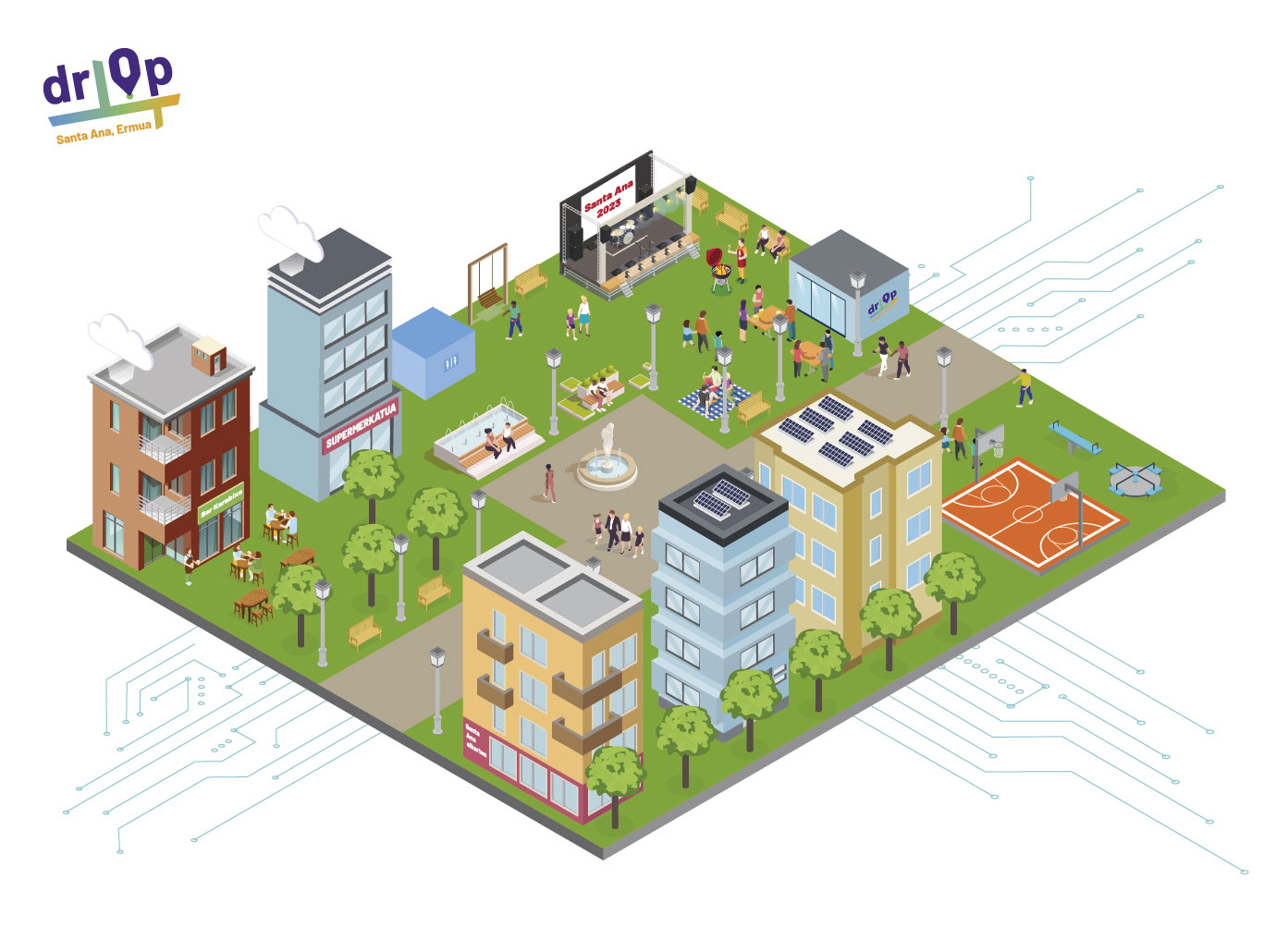
    The worst-case scenario is Santa Ana without life’. Santa Ana in 2035 presents a vision where citizens do not feel committed to the regeneration of the neighbourhood and in which the local economy has also failed to thrive. With an increasing ageing population, common and green spaces are neglected or even non-existent. The economic activity in the neighbourhood became absent, and the value of the area has decreased, with lots of empty housing. There is no sense of community and there is a lack of interest for digitalization.

    Santa Ana – Without life

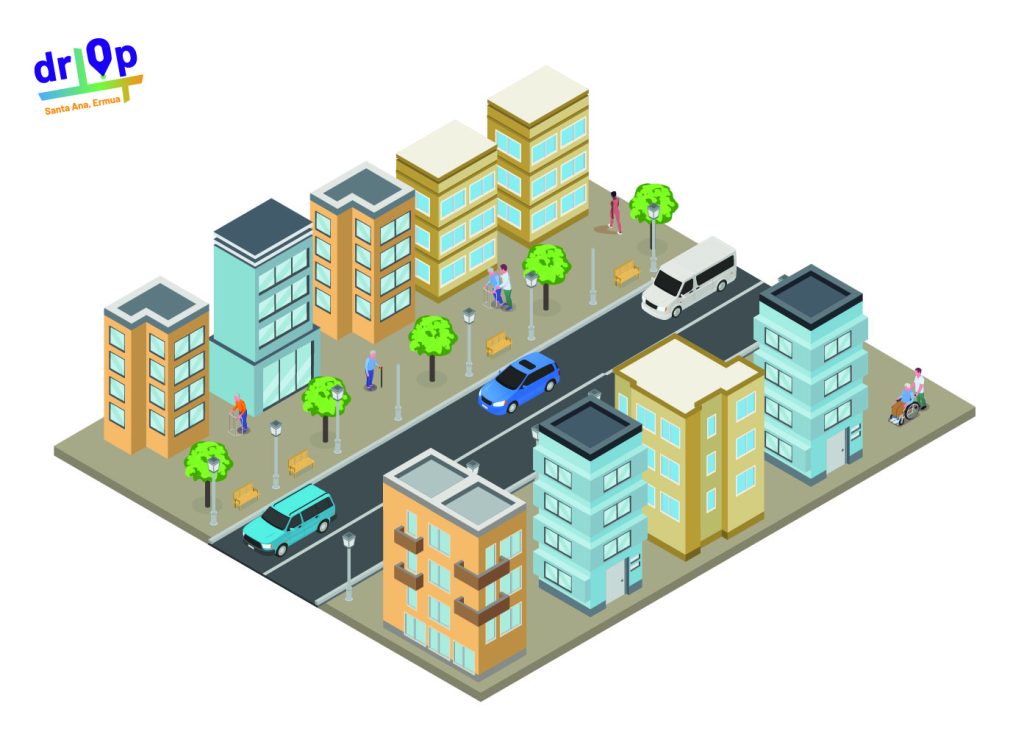
    Another possible scenario if the citizens are not committed with the process is the ‘Opportunities without owners’ scenario. Santa Ana in 2035 presents a vision where the regeneration process of the Santa Ana neighbourhood in 2035 has generated local economy but society has not engaged with the process and sees it as something alien to them. The environment was regenerated by the municipality, but it is not well maintained by the residents. Buildings were partially rehabilitated, only on the ground floor in the areas destined for hosting businesses. The economic activity is flourishing, but its character does not match with the neighbourhood’s identity. The residents do not really feel integrated and belonging to a community. While a good digital infrastructure exists, it is not fully used and appreciated by the residents.

    Opportunities without owners

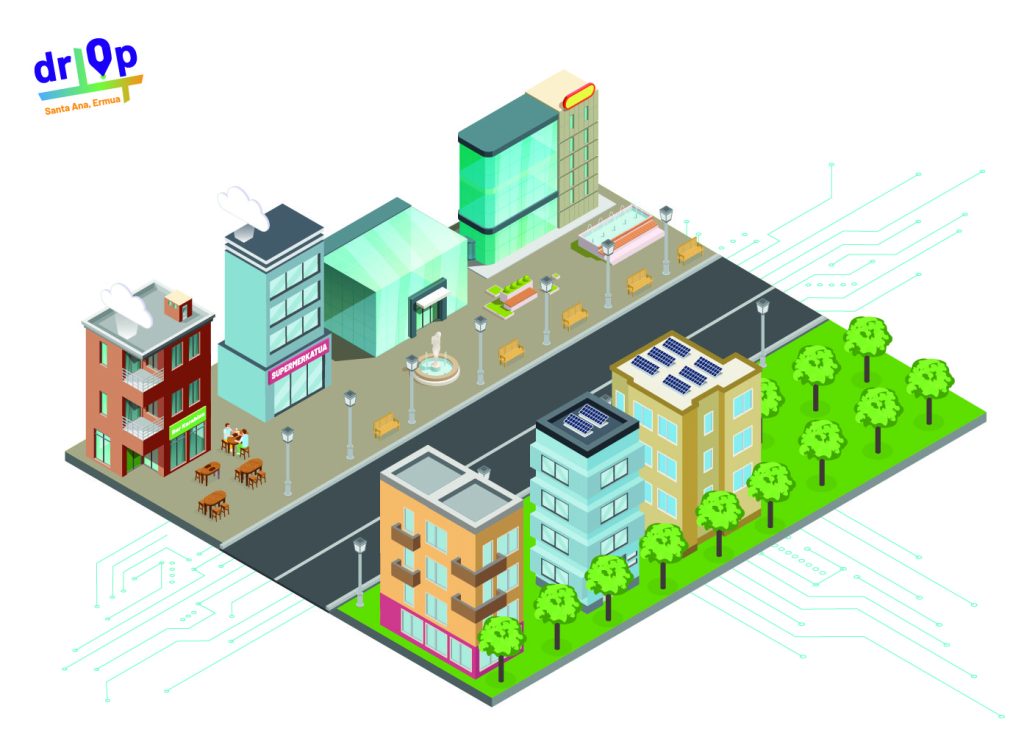
    On the other side, when the neighbourhoods are fully committed with the regeneration process, we would find ‘Santa Ana engaged, seed of Ermua’. Santa Ana in 2035 presents a vision committed to neighbourhood renewal by the majority of its citizens but fails to generate a local economy or take advantage of the innovative entrepreneurial ecosystem that exists at the municipal level. Young people are interested to move into the neighbourhood, attracted by the affordable prices even if that means renovation works are needed. From an economic perspective the average income of the residents is low, in part because the neighbourhood is not attractive given its lack of accessibility in its infrastructure. The sense of community is present, and residents often come together for energy rehabilitation activities. There is an openness towards digitalisation.

    Santa Ana engaged, seed of Ermua

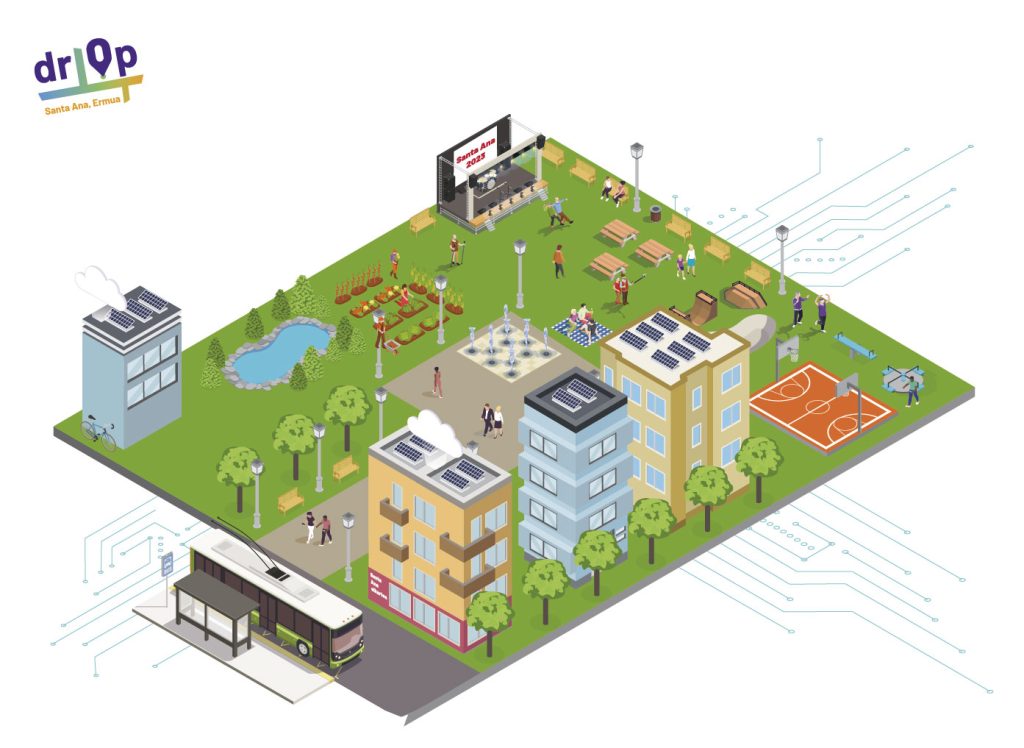
    In the best of the scenarios, there is the Santa Ana advanced community, which is a neighbourhood that fosters a sense of belonging through community collaboration. It is a green, pedestrian and, above all, accessible neighbourhood with spaces that encourage the creation of a community. The economic activity is attractive, especially because it is drive by the residents of the neighbourhood. The community and its wellbeing are one of the top priorities. Moreover, digitalisation contributes to the strengthening of the community. This ideal scenario includes urban accessibility, more green areas with outdoor and indoor living spaces and the digitalization as a tool to improve people’s quality of life as some of its key elements.

    Santa Ana, advanced community

    Taking these scenarios as a starting point, two additional workshops took place this October. Firstly, drOp partners met with residents from the district to envision with them a common, feasible and desirable scenario for the neighbourhood in 2035. During the second workshop, it was the time for local stakeholders from different areas of expertise and technicians of the municipality to meet. It was a co-creation session where participants started to identify lines of actions and initiatives to achieve the ideal scenario. It resulted in a very inspiring working day from which many interesting ideas emerged for a more sustainable, cohesive, and friendly Santa Ana for the neighbours. The remodelling of neighbourhood spaces, intergenerational camps, training in digital tools or awareness-raising campaigns in energy communities, could be some of the futures initiatives to be deployed in the district.

    Next step: co-create with the citizens exploring their preferred course of action and projects.

    *Illustrations source: https://www.freepik.es 

  • NEB or when sustainability, beauty and inclusivity take over the neighbourhood

    NEB or when sustainability, beauty and inclusivity take over the neighbourhood

    Through its objectives and expected results, drOp can also be considered a demonstration case of the New European Bauhaus, which is why it was selected as an example in one of the latest reports published under the European Committee of the Regions. NEB is an initiative designed with the purpose of bringing the European Green Deal and its transition towards climate neutrality. What does it mean in practice? It is about a movement being created to influence our societies from the perspectives of sustainability, aesthetics and inclusiveness.

    Neighbourhoods have a life of their own. This is why to make a reality the changes that everyone talks about, whether it is becoming more inclusive or implementing a fair transition, the process needs to start at this level and involve all the actors in it. While there must be a large wave to notice the impact, projects like drOp are playing their part.

    Its first and foremost mission is to demonstrate how could the Affordable Housing Initiative work in practice. For that purpose, drOp will develop an Integrated Renovation Methodology (IRM), based on the Ermua case study, with replications foreseen in Elva and Matera, and beyond. Its purpose will be to transform social housing districts into inclusive smart neighbourhoods.

    How does drOp fit in this framework? Since its main ambition is to achieve district regeneration, the IRM targets the following elements at neighbourhood level: social innovation, local economic development and the peer-learning method.

    Even though by the end of the project the actual renovation works phase will not have been reached, the IRM will be developed to cover a retrofit intervention, and to offer necessary guidelines to transform the existing buildings into accessible, beautiful, and sustainable ones. Energy efficiency will be the main driver, with the aim to rely on the use of renewable energy. At the same time citizens will be empowered to become involved in the decision-making process related to home energy consumption and comfort, encouraging them to reduce their environmental and resources footprint.

    A place where culture and creativity are present and available for anyone who is interested, cannot be anything but ‘beautiful’. Thanks to the expertise of Matera, former European Capital of Culture, cultural and creative industries will be significantly developed at the neighbourhood level, which will positively impact the local economic activities. 

    All this will be possible through the implementation of the co-creation principle, in order to strengthen social cohesion and design new ways of living together, with the ultimate purpose of achieving inclusiveness and leaving no one behind. Given the demographics of the Santa Ana neighbourhood, the focus will be more on the elderly population. From a concrete point of view, digitalisation will play a key role. The expert in this area of the project is Elva, a city in Estonia where citizens already can use a range of digital tools when it comes to administrative matters.

    All the dimensions mentioned above are closely intertwined, demonstrating a transdisciplinary approach. drOp is a project being developed at local level, but thanks to its three very different pilots (Ermua, Elva, and Matera), it will aim to be replicable and create real change. Stay with us to see what concrete solutions our partners will come up with!